What to Put on an Invoice: Mandatory and Optional Fields
The Issueable Team
Small business operations
The fields a practical invoice should include, plus the different recordkeeping, GST/HST, and VAT rules that apply in the US, Canada, and UK.
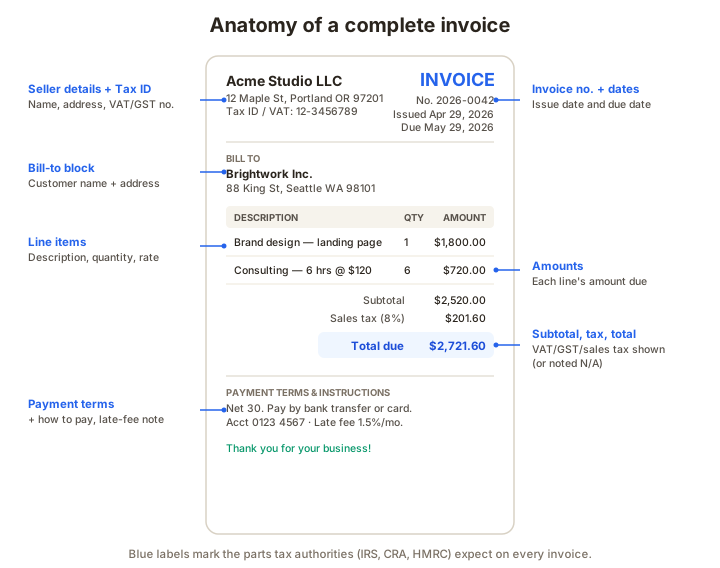
What makes a complete invoice
What belongs on an invoice depends on where the parties operate, whether tax is being charged, and the buyer's accounts-payable process. The US mainly imposes recordkeeping obligations at the federal level, while Canadian GST/HST and UK VAT rules can require specific invoice details.
Tax-compliant and buyer-friendly invoices often share the same basic details, but tax rules can add fields that an accounts-payable team would not otherwise request. Treat compliance and payment workflow as two related checklists, not one universal template.
Recommended US invoice fields and IRS records
The IRS does not prescribe a universal invoice format for ordinary businesses. It does require records that support income and expenses, and invoices are one form of supporting document. These fields make an invoice useful to both parties:
1. Seller information
Your business name, address, phone, and email. If you're a sole proprietor, use your business name or DBA (Doing Business As). If incorporated, use the legal entity name exactly as it appears in your Articles of Incorporation or business registration.
2. Seller contact and remittance details
Include the legal or trading name, address, and a way to contact you. Add an EIN only when a legitimate onboarding or payment process calls for it; do not place a Social Security number on routine invoices.
3. Customer information
The buyer's legal name and bill-to address. For business clients, include the department or named contact the buyer provided.
4. Invoice date
The date you issued the invoice and, where useful, the date or period when the goods or services were supplied.
5. Description of goods or services
What you provided. Vague descriptions ("consulting") are technically acceptable to the IRS but tend to slow payment. "Brand strategy workshop, May 14–16, 40 hours" gives the buyer's AP team something to match against.
6. Quantity and rate
For each line item, show how much you provided and the price per unit or line so the buyer can verify the total and your records support the transaction.
7. Total amount due
The sum of all line items, minus discounts, plus tax (if applicable). This is the amount the customer owes.
8. Payment terms
When payment is due (e.g., "Due on receipt," "Net 30," "Due by June 15, 2026"). The IRS doesn't mandate this, but it's critical for your accounting records and for the buyer's AP system.
Mandatory fields in Canada (CRA guidance)
Canadian GST/HST documentation requirements vary with the sale amount and the information a registered buyer needs to support an input tax credit. A clear commercial invoice should include the following, with the required GST/HST details added when applicable:
1. Seller information
Your business legal name and address. If you have a GST/HST account, include your registration number (it's required if you're registered).
2. Customer information
Include the customer's name and address, especially on invoices of $500 or more and whenever the buyer needs the document to support an input tax credit.
3. Invoice date
The date issued. Used to determine payment terms and reporting obligations.
4. Invoice number
Sequential numbering is standard practice. CRA doesn't mandate it but expects you to be able to track invoices.
5. Description of goods or services
Specific enough that you and the customer can match it to the underlying work or contract.
6. Quantity, rate, and amount
Show enough detail for the parties to identify the supply and calculate the amount paid or payable.
7. GST/HST
If you are a GST/HST registrant, disclose whether tax is included or added and provide the registration and tax information required for the sale amount. Do not label a supply exempt merely because you are not registered.
8. Total amount due and payment terms
Same as the IRS.
9. PO number (if applicable)
If the customer has a purchase order system, the PO number should match the invoice. CRA doesn't require this, but buyers often do.
Mandatory fields in the UK (HMRC guidance)
HM Revenue and Customs sets the tightest requirements:
1. Unique invoice number
UK invoices require a unique identification number; full VAT invoices use a unique sequential number from one or more series.
2. Issuing date
The full date you issued the invoice (day, month, year). On a VAT invoice this may differ from the tax point; show both if they differ.
3. Invoice period (if applicable)
If the invoice covers a period of work (e.g., "May 1–31, 2026"), show the period clearly. For one-off work, this isn't needed.
4. Seller name and address
Business legal name and full address. If you have a VAT registration number, include it.
5. Seller's VAT registration number
Required on a VAT invoice. The UK registration threshold is £90,000 of taxable turnover in a rolling 12-month period as of July 2026, with separate rules for businesses that expect to exceed it in the next 30 days and for non-established taxable persons.
6. Customer name and address
Full details — both are required on a full VAT invoice.
7. Description of goods or services
Specific and clear. Vague descriptions trigger HMRC inquiries.
8. Quantity and rate per unit
For each item. The calculation must be transparent.
9. Total amount due
Clear and unambiguous.
10. VAT amount and rate
If VAT applies, show the rate (standard rate is 20% in the UK) and the amount. If the supply is VAT-exempt or zero-rated, note it.
Important: If you're invoicing a business customer outside the UK (e.g., a US-based company), most services fall outside the scope of UK VAT. Show "Reverse charge — customer to account for VAT" or "VAT not charged — customer is outside the UK." B2C sales to overseas consumers follow different place-of-supply rules; check HMRC's guidance.
Optional fields that reduce friction
Beyond required fields, these additions often reduce payment questions:
1. PO number
If your customer uses purchase orders, ask whether its AP process requires the PO number on the invoice. Include the exact reference the buyer provides.
2. Contract or statement of work reference
Example: "Per SOW dated May 5, 2026." This ties the invoice to the original agreement and survives AP review.
3. Invoice due date (not just terms)
Instead of "Net 30," write "Due: May 31, 2026." A specific date is easier for the buyer to act on than a relative term.
4. Payment instructions
Bank account, Stripe link, PayPal, or a pay link. Anything that lets the buyer pay without sending a follow-up email.
5. Late-fee clause
State a late fee only if it was agreed in advance and is permitted under the governing law. Include the trigger date, rate, and calculation basis; do not assume a common template rate is valid everywhere.
6. Early-payment discount (optional)
Example: "2% discount if paid within 10 days." Worth offering only if you need immediate cash; for most small businesses the cost-benefit doesn't add up.
7. Business logo or branding
A professional touch that signals reliability. Optional but high-impact.
8. Thank-you message or brief note
"Thanks for the opportunity to work on this project" adds warmth without appearing unprofessional.
9. Discount or promo code
If you offered a discount, show it as a line item: "15% early-bird discount: -$750.00." This helps the buyer understand the invoice amount.
10. Project name or work order number
If the work was part of a larger project, include the project name or internal reference number. Large buyers track work across projects; this helps AP match it to the right cost center.
The complete invoice checklist
Core invoice fields:
- Your business name and address
- Customer name and address
- Invoice date
- Description of goods or services provided
- Quantity and rate or total amount
- Total due
- VAT/GST/Sales Tax (if applicable, or note if not applicable)
Check for your region and tax status:
- Invoice number and sequence
- GST/HST or VAT registration number and required tax breakdown
- Supply or tax-point date
- Customer details required for the invoice type and amount
Highly recommended for faster payment:
- Specific invoice due date (not just "Net 30")
- PO number (if customer provided one)
- Payment instructions
- Professional layout and branding
- Late-fee clause, if agreed and permitted by the governing law
Nice to have:
- Early-payment discount (if you need immediate cash)
- Contract or SOW reference
- Thank-you message
- Project or cost-center reference
Regional edge cases
Invoicing a US customer from Canada: Registration alone does not decide whether GST/HST applies. Determine the place of supply and whether the sale qualifies as a zero-rated export under CRA rules. Show your GST/HST registration details when the applicable invoice rules require them.
Invoicing a Canadian customer from the US: Do not assume a foreign seller is outside Canada's GST/HST rules. Registration can depend on what you sell, whether you carry on business in Canada, the customer's status, and the relevant registration regime. Use the agreed currency and collect Canadian tax only when registered or required to register.
Invoicing a UK customer from the US or Canada: UK VAT treatment depends on the supply and customer. Many cross-border B2B services use the reverse charge, while goods, digital services, and consumer sales can follow different rules. Confirm the place-of-supply treatment before adding a VAT note.
Invoicing as a non-resident (e.g., a Canadian freelancer invoicing a US customer): You're not required to show a US tax ID. Show your Canadian business info and currency (CAD). For large invoices, US buyers often ask for a W-8BEN form (US tax exemption for non-residents); have one ready.
Ready to create a compliant invoice?
Issueable's invoice generator calculates the tax rate you enter and gives you room for invoice numbers, customer details, line items, dates, terms, and notes. Check the requirements for your jurisdiction, then create the invoice.
Frequently asked questions
- Is it legal to invoice without an invoice number?
- The IRS does not prescribe one invoice-number format for ordinary US businesses, but state tax rules, regulated industries, government contracts, and buyer systems can impose their own requirements. Give every invoice a unique, traceable identifier even when a strict sequence is not legally required.
- What if I don't collect sales tax? Do I still need to mention it on the invoice?
- If the sale is not taxable, the invoice can usually omit the tax line or identify the applicable exemption. If you collect tax, itemize it clearly and follow the invoice and recordkeeping rules for the jurisdiction where the sale is taxed; required fields vary.
- Can I invoice without the client's address?
- US requirements vary by transaction, state, industry, and buyer; there is no single federal invoice format for every ordinary business. In Canada, customer information requirements depend on the invoice amount and the buyer's input-tax-credit needs. A full UK VAT invoice must show the customer's name and address. Include the bill-to address when the buyer provides one because it also reduces AP friction.
- Do I need to include my tax ID on every invoice?
- In the US, an EIN is not generally required on an ordinary invoice, and you should not put a Social Security number on routine invoices. Canadian GST/HST registrants and UK VAT-registered businesses have registration-number rules for qualifying tax invoices. Follow the rule for the document and jurisdiction rather than adding sensitive identifiers for appearance.
- What if my client asks me to invoice a different company than the one they work for?
- Invoice the entity that signed the contract or purchase order. If they ask you to bill a parent company or subsidiary instead, get written confirmation (email is fine) of the new bill-to address and entity name. Update your records and use that entity name going forward to avoid AP confusion.
- Is there a difference between a 'tax ID' and a 'business number' on an invoice?
- They are not interchangeable. An EIN identifies a US taxpayer, a Canadian business number can include GST/HST program accounts, and UK UTR and VAT registration numbers serve different purposes. Include the identifier required for that invoice type; do not publish another tax identifier just to make the invoice look official.