Invoicing in USD vs CAD: Cross-Border Currency Decisions
The Issueable Team
Small business operations
When to invoice in the client's currency vs. your own. Currency conversion costs, GST/HST handling, and best practices for cross-border invoicing.
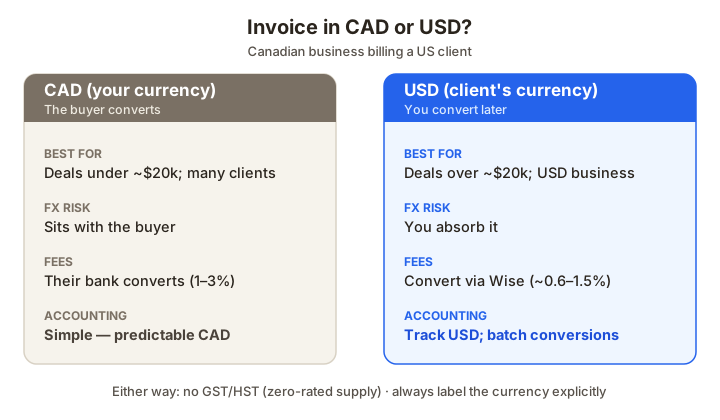
The fundamental decision: whose currency?
If you're a Canadian business billing a US client (or vice versa), you face a choice: invoice in USD or CAD — the buyer's currency or your own?
There's no universal rule. Deal size, payment frequency, your risk tolerance, and how volatile the rate has been all push the answer one way or the other.
As a general principle: invoice in your home currency when you want to avoid FX risk, and in the buyer's currency when you're competing for the deal or when they're large enough to demand it.
Invoice in your home currency (CAD for Canadian businesses)
Pros:
- No currency risk. You know exactly how much CAD you'll receive.
- Simpler accounting. Your invoice amount matches your bank deposit (roughly, minus conversion fees).
- Standard practice. Most Canadian small businesses invoice in CAD.
- Less negotiation. The buyer expects to pay in their own currency anyway.
Cons:
- The buyer has to convert and may pay transfer fees or an exchange-rate spread.
- Some US buyers require USD invoices as part of their purchasing process.
- You're not accommodating their preference, which may hurt relationship-building.
When to use it:
- You want predictable CAD revenue and do not hold or spend much USD.
- You have occasional US clients and want simpler bookkeeping.
- You're a solopreneur or small business and want to keep things simple.
- The buyer hasn't asked for a specific currency.
Example: A Canadian web designer invoicing a US client: "Invoice amount: $5,500 CAD. Payment via bank transfer (USD converted at your bank's rate), Wise, or Stripe."
Invoice in the buyer's currency (USD for US clients)
Pros:
- Easier for the buyer. They pay in USD without conversion, which removes friction.
- Competitive advantage. Showing pricing in their currency signals that you understand their market.
- Reduces negotiation. Some US buyers will only accept USD invoices.
- It can fit larger or recurring relationships where the buyer budgets in USD.
Cons:
- Currency risk. If CAD strengthens between invoice and payment, you receive fewer CAD.
- More complex accounting. You need to track USD accounts or convert regularly.
- Conversion costs still exist. Even if you invoice in USD, you'll eventually convert to CAD and pay conversion fees.
- Ongoing relationships. If USD prices fluctuate, you may need to renegotiate.
When to use it:
- The buyer requires or strongly prefers USD.
- Your business operates primarily in USD (multiple US clients, USD revenue, USD expenses).
- The buyer has asked for USD pricing.
- You have a long-term relationship with the buyer.
Example: A Canadian consultant with multiple US clients: "Invoice amount: $8,000 USD. Payment via bank transfer, Wise, or Stripe."
Currency conversion costs: where money goes
If you invoice in USD and eventually convert to CAD, compare the whole transaction rather than one advertised fee:
Bank or wire transfer
- Ask for the exchange rate and every sending, receiving, and intermediary-bank fee.
- Some USD accounts let you receive funds without converting immediately.
Money-transfer service
- Record the quoted fee, rate, delivery method, and final CAD amount.
- Compare the quote with your bank on the same amount and at nearly the same time.
Card processor
- Separate the payment-processing fee from any currency-conversion charge.
- Check which party chooses the conversion currency and whether refunds reverse every fee.
Digital wallet
- Compare the offered exchange rate with an independent reference.
- Review the business-payment fee schedule for both sender and recipient countries.
Strategy: how to minimize FX costs
If you're invoicing in USD and need to convert to CAD, here's the cost-minimizing approach:
-
For regular USD income: Consider a USD business account. Holding USD can reduce unnecessary conversions when you also have USD expenses, but batching does not automatically produce a better rate, so compare a live quote before converting.
-
For a large one-time payment: Get same-day, all-in quotes from your bank and at least one specialist transfer provider. Compare the CAD that will actually arrive.
-
Use payment processors carefully. Card acceptance can be worth the convenience, but compare its current processing and FX costs with a bank transfer before choosing a default.
-
Invoice in batches. If you have multiple US invoices, batch them together and convert once per month instead of converting each invoice individually.
GST/HST and cross-border invoicing
This is where most Canadian businesses get confused. Here are the rules:
Canadian supplier to US customer:
You do NOT charge GST/HST. The supply is "zero-rated" under Canadian tax law, meaning you don't collect tax but you can claim input tax credits on expenses.
Your invoice should show:
- Amount: $5,000 CAD (or USD)
- Tax: 0% GST/HST: supply is zero-rated (or simply omit the tax line)
You still report the sale on your GST/HST return at 0%, and you keep claiming input tax credits on related expenses — you just don't collect tax from the customer.
Canadian supplier to US customer who's registered for GST/HST in Canada:
This is rare, but it happens with large US companies. If the customer has a Canadian GST/HST registration number, ask them: "Are you registered for GST/HST in Canada?"
If yes, don't assume the zero-rating applies automatically — the export rules for services have exceptions, and a registered non-resident may have to self-assess tax on the purchase instead. Note their registration number on the invoice and confirm the correct treatment with your accountant or the CRA before you bill.
US supplier to Canadian customer:
For B2B services, you do NOT charge GST/HST — as a non-resident supplier with no Canadian registration, there's no Canadian tax for you to collect. Your invoice shows the amount in USD with no Canadian tax.
The Canadian business buyer may have to self-assess GST/HST, but that's their responsibility, not yours. One exception to know: non-resident vendors selling digital products or services to Canadian consumers must register for the simplified GST/HST regime once those sales pass CAD $30,000 in a 12-month period.
Special case: physical goods (not services) to US:
If you're selling physical products to the US, the rules are the same, no GST/HST. But provincial sales tax, US state sales tax, and tariffs come into play, which is more complex. For services, this isn't an issue.
Multi-currency pricing in long-term contracts
If you have an ongoing relationship (retainer, annual contract), consider a multi-currency clause:
"This contract is priced at $X CAD or $Y USD. Exchange rate: 1 CAD = 0.71 USD (as of [date]). If the exchange rate moves by more than 5% for more than 30 consecutive days, either party may request to renegotiate pricing."
This protects both of you from extreme FX swings without requiring a new contract every time the loonie moves.
The practical workflow for Canadian invoices to US clients
- Agree on a currency at the start. Email: "We can invoice in CAD or USD, what's your preference?"
- Invoice in that currency. Example: "Invoice Amount: $5,000 CAD. Exchange reference rate (informational only): 1 CAD = 0.71 USD." Use the live mid-market rate on the day you invoice; it moves.
- Provide payment instructions. Example: "Payment via bank transfer (USD converted at your bank's rate), Wise, or Stripe."
- Accept the payment. The buyer's bank, Wise, Stripe, or PayPal will handle conversion. You receive it in CAD (or USD if you have a USD account).
- Convert to CAD if needed. Compare live, all-in quotes and keep the conversion record for bookkeeping.
W-8BEN for cross-border work
If you're a Canadian (non-US tax resident) invoicing a US buyer, the buyer may ask for a W-8BEN form (Certificate of Foreign Status of Beneficial Owner for US Tax Withholding and Reporting). The W-8BEN itself doesn't have a dollar threshold: US withholding agents are supposed to collect one from any foreign payee whose income is subject to US withholding, regardless of amount. In practice, many US payers wait until the engagement crosses the 1099-NEC reporting threshold ($2,000 per payee per year for 2026 payments under the One Big Beautiful Bill Act, raised from $600) before bothering, but you may be asked at any amount.
This is a US tax form that tells the buyer, "I'm not a US tax resident, so don't withhold US taxes on my income." It's simple to fill out; the IRS provides the form for free. Having it ready avoids payment delays.
You'll only need one W-8BEN per buyer, and it's valid for three years.
Invoice examples
Canadian business invoicing a US client in CAD:
Invoice: INV-0150
Due Date: June 15, 2026

Description: Website redesign project
Amount: $5,000.00 CAD

Tax: $0.00 (zero-rated supply: client is outside Canada)
Total: $5,000.00 CAD

Payment: Bank transfer (USD or CAD), Wise, or Stripe
Canadian business invoicing a US client in USD:
Invoice: INV-0150
Due Date: June 15, 2026

Description: Website redesign project
Amount: $3,550.00 USD

Tax: $0.00 (client is outside Canada)
Total: $3,550.00 USD

Payment: Bank transfer, Wise, or Stripe
Exchange reference: 1 CAD = 0.71 USD (informational)
US business invoicing a Canadian client (no GST/HST):
Invoice: INV-0150
Due Date: June 15, 2026

Description: Consulting services
Amount: $5,000.00 USD

Tax: $0.00
Total: $5,000.00 USD

Payment: Bank transfer or PayPal
When currency decisions matter: case studies
Case study 1: Canadian freelancer, US client, small retainer
A Canadian graphic designer invoices a US design agency $2,000 USD per month.
Decision: Invoice in CAD.
Why: The retainer is ongoing, so currency swings matter. By invoicing in CAD, the designer knows the contractual CAD amount. The US agency handles conversion at its provider's rate and fees.
Math: At 1.40 CAD/USD, the designer prices the retainer at $2,800 CAD. Whether the loonie sits at 1.40 or 1.45 when the agency pays, the designer still receives $2,800 CAD. The agency's USD cost moves with the rate — the designer's revenue doesn't. That's the point of invoicing in your home currency.
Case study 2: US consultant, Canadian corporate client, large project
A US management consultant bills a major Canadian retailer for a $75,000 project.
Decision: Invoice in USD.
Why: The deal is large and the client is enterprise. Canadian corporations keep USD accounts for US vendors. Invoicing in USD ($75,000) is simpler than the CAD equivalent (about $105,000 at 1.40).
Cost: The consultant receives $75,000 USD with no FX cost at all. The client pays from a USD account or converts at their treasury rate (usually better than retail). Cleaner for both sides than invoicing in CAD and arguing over whose rate applies.
Case study 3: Canadian business, recurring US clients, multiple deals
A software company with 20+ US clients, each paying $1,000–$5,000 monthly.
Decision: Set up USD accounts and invoice in USD.
Why: The company collects USD payments in a USD business account, pays any USD expenses from that balance, and converts only what it needs in CAD. Before each conversion, it compares live all-in quotes. This reduces unnecessary conversions without relying on a provider or fee estimate that may change.
Currency fluctuations and profitability
Currency risk is real. A Canadian developer who invoices in USD is exposed to every move in the rate over the year. The swing cuts both ways:
- Invoice: $1,000 USD per month × 12 = $12,000 USD
- At 1.40 CAD/USD: $16,800 CAD
- At 1.50 CAD/USD (USD stronger): $18,000 CAD: $1,200 more
- At 1.30 CAD/USD (USD weaker): $15,600 CAD: $1,200 less
For large USD-invoicing businesses, this swing is material. Many lock in exchange rates or hedge, but that's beyond the scope of most small businesses. The simple strategy: invoice in your home currency to avoid the risk.
Ready to invoice internationally?
Issueable's invoice generator lets you choose one currency for each document, including CAD or USD. It does not convert exchange rates, so state the agreed currency explicitly and record any home-currency conversion in your accounting system.
Frequently asked questions
- Should I invoice in CAD or USD if my client is in the US?
- If you're Canadian, invoice in CAD (your home currency) to avoid currency risk. The buyer can pay in USD and their bank converts it. However, if the buyer strongly prefers USD or your entire business operates in USD, invoicing in USD is acceptable; just be aware you're absorbing the FX risk. For most Canadian small businesses, CAD invoices are simpler.
- How much does currency conversion cost?
- It depends on the provider, payment method, account type, amount, and exchange rate offered at that moment. Compare the recipient's final CAD amount, including transfer fees, card-processing fees, and the spread between the quoted rate and an independent reference rate. A provider advertised as low-fee is not necessarily cheapest for every transaction.
- Do I need to charge GST/HST to US clients?
- Many services supplied by a Canadian registrant to a non-resident customer are zero-rated, but the Excise Tax Act contains exceptions. Confirm the place-of-supply and zero-rating rules for the particular service and customer. If the supply is zero-rated, charge GST/HST at 0%, retain supporting records, and report it as required on the return.
- What if a US client is registered for GST/HST in Canada?
- It can change the tax treatment, so ask: 'Do you have a Canadian GST/HST registration number?' If yes, note the number on the invoice and confirm the correct treatment with your accountant or the CRA before invoicing; the zero-rating rules for exported services have exceptions, and a registered non-resident may need to self-assess tax instead. This is rare but happens with large US companies doing business in Canada.
- Should I lock in an exchange rate on my invoice?
- A one-time invoice usually needs only a clearly stated currency. For a long project or material foreign-currency exposure, the contract can use a dated reference rate, a repricing band, shorter billing milestones, or a hedging arrangement. The right trigger depends on the business's risk, not a universal invoice amount.
- What if the exchange rate moves between invoice and payment?
- The party converting currency bears the immediate rate risk unless the contract says otherwise. For illustration, a $10,000 USD invoice converts to $14,000 CAD at 1.40 CAD/USD and $13,500 CAD at 1.35, a $500 difference before fees. Use live rates when making a real decision.