Net 30 vs Net 15 vs Due on Receipt: Payment Terms Explained
The Issueable Team
Small business operations
How payment terms affect your cash flow, buyer friction, and collections load. Rules of thumb by client type: B2B enterprises, SMBs, and one-off clients.
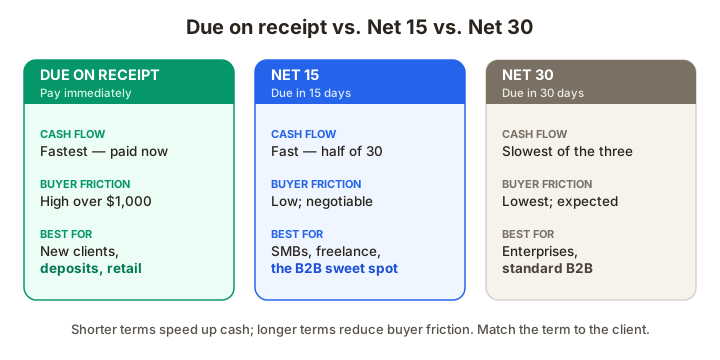
Payment terms 101: what they mean and why they matter
Payment terms look simple — "Net 30" or "Due on Receipt" — but the term you pick decides how fast cash comes in, how much chasing you'll do, and what the buyer assumes about the relationship.
The right term depends on the contract, the buyer's payment process, your bargaining position, and how much credit risk your business can carry.
The four terms you'll see most
Due on Receipt
Payment due immediately, ideally before or at the time of delivery.
When to use it:
- One-off retail or e-commerce sales
- New clients you haven't worked with before
- High-risk clients with a history of non-payment
- Deposits on project work (e.g., "50% deposit due on receipt")
- Upfront service fees
Pros:
- Requests payment without extending a net period
- Can reduce credit exposure when payment is collected before delivery
Cons:
- Creates friction with buyers who expect trade credit
- Some buyers cannot process immediate payment
- Can feel punitive to established relationships
Cash-flow impact: Potentially positive, but "due" does not mean "paid." Use a deposit or payment-before-delivery workflow if you need to avoid extending credit.
Net 15
Payment due within 15 calendar days of invoice date.
When to use it:
- Clients whose approval process can support a 15-day window
- Freelance or contractor relationships (design, writing, development)
- Clients with a history of slow payment
- When your cash needs are urgent
- Monthly retainers or ongoing projects with predictable billing
Pros:
- Much faster cash flow than Net 30: roughly half the payment window
- Feels less punitive than "Due on Receipt"
- Collections conversations happen sooner (you're flagging delays at day 16, not day 31)
Cons:
- Some buyers see 15 days as too aggressive; they may push back
- Requires more frequent collections follow-ups if they slip
Cash-flow impact: Positive. You're financing 15 days instead of 30.
Net 30
Payment due within 30 calendar days of invoice date.
When to use it:
- Buyers whose agreed AP cycle supports it
- Established clients and ongoing vendor relationships
- Mid-market and enterprise buyers (their AP cycles expect this)
- When you've already agreed to longer terms on a contract
Pros:
- Familiar to many B2B buyers
- Gives the buyer time to route and approve the invoice
Cons:
- You finance the receivable until payment arrives
- Collections conversations don't start until day 31+
Cash-flow impact: Slower than upfront, due-on-receipt, or Net 15 terms. Model the actual collection date rather than assuming payment will arrive on day 30.
Net 60 / Net 90
Payment due within 60 or 90 calendar days.
When to use it:
- Large enterprise contracts (you often don't have a choice)
- When it's a condition of the contract you signed
- Government contracts, which may use statutory or contract-specific payment rules
- Long-term partnerships where the buyer has leverage
Pros:
- Sometimes non-negotiable with enterprise buyers
- Shows you can accommodate their AP process
Cons:
- You're financing 60–90 days of working capital — significant for small businesses
- A late payment extends an already long collection period
- Materially impacts your cash flow and requires more careful cash management
Cash-flow impact: Negative. You need working capital or a line of credit to float these invoices.
How payment terms affect your cash flow
Let's say you invoice for $10,000 on May 1 under different terms:
Due on Receipt: The $10,000 is due immediately, but the actual payment date still depends on the buyer and payment method.
Net 15: If the invoice date starts the clock, the due date is May 16.
Net 30: If the invoice date starts the clock, the due date is May 31.
Net 60: If the invoice date starts the clock, the due date is June 30.
Over a year, if you invoice $100,000 monthly, the difference between Net 30 and Net 60 is $100,000 sitting in limbo. That's working capital you have to finance with a line of credit, which costs money.
Rules of thumb by client type
Fortune 500 / Large Enterprise
Terms they'll accept: Net 30, Net 60, or Net 90 (often their choice, not yours).
Strategy:
- Price the delay deliberately. Compare your financing cost and collection risk for Net 60 with Net 30, then negotiate price, milestones, or an early-payment option.
- Build invoicing into your contract upfront. Don't accept surprises after you've started work.
- Ask for a deposit or milestone payments to reduce the outstanding balance.
- Track who approves invoices at the client. Don't address invoices generically to "Accounts Payable."
Collections: Confirm receipt before the due date if the process is complex, then follow up promptly after the agreed due date.
Mid-Market (50–500 people)
Terms they'll accept: Net 30 or Net 45 (negotiable).
Strategy:
- Propose the shortest term that fits the buyer's approval process and your cash-flow needs.
- If they ask for Net 45, ask them to split the difference: "Net 30, with an automatic 5-day grace period for processing" (i.e., de facto Net 35).
- Offer an early-payment discount only if the economics work and the buyer will use it.
- Include a PO number when the buyer requires one.
Collections: Follow up shortly after the due date, keeping the tone proportional to the relationship and payment history.
SMB / Freelance Clients (under 50 people)
Terms they'll accept: Net 15, Net 30, or Due on Receipt (varies widely).
Strategy:
- Default to Net 15 if they're new or have slow-payment history.
- Use Net 30 for established, reliable clients.
- Offer "Due on Receipt" as a lower price. Example: "Net 30 is $5,000; Due on Receipt is $4,850." (This incentivizes immediate payment and covers the cost of float.)
- Get a clear verbal or email agreement on terms before you send the invoice. Don't surprise them with a term they didn't see coming.
Collections: A friendly reminder shortly after the due date is a sensible first step.
Individuals / One-off Clients
Terms they'll accept: Due on Receipt (expected).
Strategy:
- Consider "Due on Receipt," a deposit, or payment before delivery for one-off work.
- If they ask for time to pay, decide whether a deposit, milestone plan, or written payment schedule manages the risk.
- Extend credit only after considering the amount, relationship, and applicable consumer rules.
Collections: Follow the agreed terms and use proportionate reminders; the amount and circumstances determine whether further collection is worthwhile.
How to choose the right term for a new client
Ask yourself three questions:
-
How much exposure can you carry? Compare the invoice with your available working capital and concentration risk.
-
Do you have a relationship history? New clients should get shorter terms (Due on Receipt or Net 15) until you trust them. Established clients can get Net 30 or Net 45.
-
How tight is your cash? If you're cash-constrained, use shorter terms. If you have working capital, you can afford Net 30 or Net 45.
Once you've answered these, propose a term your business can support and document the final agreement clearly.
Changing terms mid-relationship
If a buyer is consistently late, you can propose tighter terms for future invoices. Frame it as an operational change, not a penalty:
"Thanks for the great work on the project. Going forward, we'd like to move invoices to Net 15 so our cash planning is steadier. Does that work for you?"
The buyer may accept, reject, or negotiate the proposal. Document any change before applying it to future work.
Do not assume you can unilaterally change terms or add a new late fee to an existing balance. Agree on changes before applying them to future work and check the contract and governing law.
Ready to set the right terms?
Issueable's invoice generator lets you set custom payment terms on every invoice. Start now.
Frequently asked questions
- What does 'Net 30' actually mean?
- Net 30 generally means the full amount is due 30 calendar days after the agreed starting date, often the invoice date. State the actual due date because a contract or buyer process may start the clock from receipt or acceptance instead. '2/10 Net 30' usually offers a 2% discount for payment within 10 days, with the full amount due under the Net 30 term.
- Which payment term speeds up my cash flow the most?
- Due on receipt asks for the earliest payment, but it does not guarantee immediate settlement. The best term is one the buyer accepts and can process: upfront payment or a deposit limits credit risk, while Net 15, Net 30, and longer terms trade slower cash collection for buyer flexibility.
- Can I change payment terms mid-contract?
- Only if you and the buyer agree. If you set Net 30 at the start and the buyer is paying late, you can't retroactively change it to Net 15. For future invoices, you can propose a new term, but expect pushback. It's easier to set the right term upfront.
- What if the buyer insists on Net 60 or Net 90?
- For some enterprise buyers, longer terms are difficult to change. If you accept Net 60, calculate the financing cost, collection risk, and cash-flow impact rather than adding a stock percentage. You may be able to negotiate price, milestones, a deposit, or an early-payment option even when the stated term is fixed.
- Should I offer an early-payment discount?
- An early-payment discount can accelerate cash flow, but compare the discount with your financing cost and the chance it will change the buyer's behavior. Forgoing 2% to receive 98% twenty days early has a simple annualized cost of roughly 37%; the exact comparison depends on timing and compounding.
- What's the legal difference between Net 30 and a contract that says Net 30?
- A term in an accepted contract is stronger evidence of the parties' agreement than a new term first introduced on an invoice. Whether invoice language becomes part of an agreement depends on the transaction, prior dealings, acceptance, and governing law. Agree on payment terms before work begins and do not assume a line on the invoice is automatically enforceable.