How to Get Paid Online: Cards vs ACH vs Pay Links
The Issueable Team
Small business operations
Cards, ACH, and hosted pay links have different fees, settlement times, risks, and buyer requirements. Compare the current terms before choosing what to offer.
A pay button can remove payment friction
A hosted payment link can make payment easier for buyers who are permitted to use it. It does not override the buyer's approval cycle, contract terms, cash position, or procurement process, and some business buyers require bank instructions or a vendor portal instead.
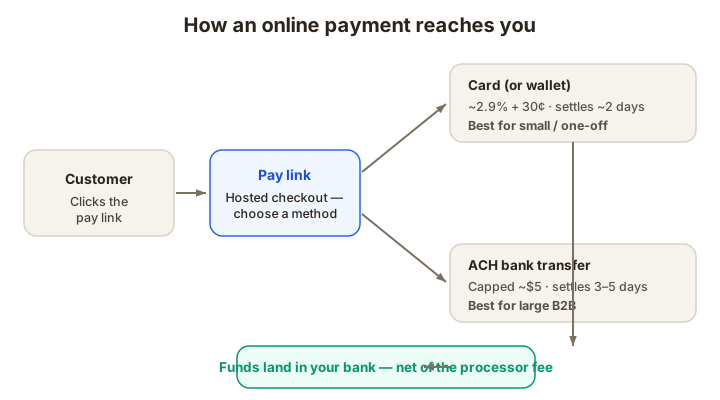
The first decision is just to offer one at all. After that, the method matters, because it quietly determines how much of each payment you keep and how fast it lands. The three options worth knowing are cards, ACH bank transfer, and the pay link that delivers either one.
The three ways to get paid online
Credit and debit cards. The default, and the one buyers expect. Easiest to set up, fastest to settle, and the only realistic option for consumer-facing or one-off work. The cost is a percentage of every transaction.
ACH (bank transfer). The buyer authorizes a debit or sends a credit through the banking network. It can cost less than cards on larger amounts under some processor plans, but timing, caps, return risk, and setup vary.
Pay links and buttons. Not a separate payment rail, but a delivery mechanism. A pay link is a URL (or a button on the invoice) that opens a hosted checkout where the buyer chooses card or bank. The link is what removes the friction; the rail behind it is still a card or ACH.
Digital wallets such as Apple Pay and Google Pay commonly sit on top of card rails. Many processors charge their normal card rate, but the underlying card and account pricing still control.
What each method actually costs
This is where the choice has real money attached. Approximate 2026 rates for the three processors most small businesses use:
| Method | Typical fee | On a $200 invoice | On a $5,000 invoice |
|---|---|---|---|
| Card (Stripe) | 2.9% + 30¢ | ~$6.10 | ~$145 |
| Card (Square invoice) | 3.3% + 30¢ (2.9% on paid plans) | ~$6.90 | ~$165 |
| Card (PayPal) | 2.99–3.49% + 49¢ | ~$6.50–$7.50 | ~$150–$175 |
| ACH (Stripe) | 0.8%, capped at $5 | ~$1.60 | $5 |
| ACH (Square invoice) | 1% (min $1; capped at $10 on paid plans) | $2 | ~$10 |
Read the two right-hand columns together. On a $200 invoice the difference between a card and ACH is a few dollars, not worth thinking about, so take the card and the convenience. On a $5,000 invoice it's roughly $140, every single time. If you send a handful of large B2B invoices a month, offering ACH instead of defaulting everyone to a card is one of the cleanest margin improvements available; you're changing a setting, not your prices.
The flat per-transaction component matters more on small card payments, while an ACH cap can make a large bank payment much cheaper under the plans shown. There is no universal crossover point: compare the live fee schedule, return fees, payout timing, and buyer preference for the invoice in front of you.
Who pays the fee: you or the client?
By default, you do — the processor deposits the invoice amount minus its cut. There are three ways to handle that.
The simplest is to absorb it and price it in. If your effective card cost is around 3%, building it into your overall pricing avoids a separate fee conversation. Whether that is preferable depends on your margins, customer mix, and local surcharge rules.
The second is to surcharge — pass the credit-card fee to the buyer as a separate line. This is legal in most US states but hedged with rules: it's capped (commonly 3%), you have to disclose it before they pay, you can never surcharge a debit card, and a few states restrict or prohibit it entirely. The rules change periodically, so confirm your state's current law before adding a fee. Done wrong, it's a compliance problem; done right, it's still a point of friction that can cost you goodwill.
The third is to steer toward ACH. Offer both methods, but make bank transfer the obvious choice on large invoices. You're not charging the client anything extra; you're just defaulting the cheaper method to the situations where the difference matters.
A "convenience fee" is a narrower, more regulated cousin of a surcharge and isn't a general-purpose tool for service invoices. If you want to itemize the cost, surcharging within your state's rules is the cleaner mechanism.
Speed: when the money lands
Cost isn't the only axis; settlement time matters when you're managing cash.
- Cards may be available quickly, but payout schedules and risk holds vary.
- ACH timing depends on debit or credit flow, verification, return windows, processor, and bank.
- Mailed checks add postal and buyer-processing time, but there is no universal delivery-to-funds interval.
If timing is critical, compare the actual availability dates shown by the processor rather than assuming a two-day card payout or a fixed ACH delay. The cheaper rail is useful only if its verification, hold, and return risk fit your cash needs.
How to choose, in one rule
Match the method to the invoice:
- Small, one-off, or consumer-facing → card (and enable wallets). Convenience may outweigh the fee, but payout is not necessarily same-day.
- Large or recurring B2B → ACH, with card as a backup. The capped fee saves real money, and corporate AP departments often prefer bank transfer anyway.
- Subscriptions or retainers → a card or bank account kept on file and charged automatically, so there's no invoice to chase. (See recurring invoices.)
Offer both rails when practical and let the buyer self-select. Some business customers will still require a check, bank instruction sheet, or procurement portal.
A bookkeeping note
Processors often deposit the net amount after fees, so the bank deposit may not match the invoice. Record gross revenue, fees, refunds, and tax in the accounts appropriate to your accounting method. Processing fees are often deductible business expenses when they are ordinary, necessary, and substantiated, but classification and timing can vary.
Add a pay link to your next invoice
Issueable invoices are built to carry a pay link, so the "Pay this invoice" button rides along on the PDF and the buyer can settle in a click. Create an invoice and give your client the easiest possible path to paying you.
Frequently asked questions
- What's the cheapest way to get paid online?
- For the US processor plans reviewed here, ACH can cost less than cards on larger invoices, but eligibility, caps, return fees, verification, and pricing vary. Stripe currently lists 0.8% capped at $5 for ACH Direct Debit; Square lists 1% with plan-dependent caps for invoice ACH. Check a live quote and the full fee schedule before choosing.
- How fast does money actually arrive?
- Payout timing varies by processor, account history, payment method, risk review, weekends, and bank. Check the provider's displayed availability date for the actual account rather than assuming every card settles in two days or every ACH payment in three to five.
- Can I charge the customer the processing fee?
- Sometimes. Passing a credit-card fee on to the buyer is called surcharging, and it's allowed in most US states but capped (commonly 3%) and subject to card-network rules; you must disclose it up front and you can never surcharge a debit card. A handful of states restrict or ban surcharging outright, and the rules change, so confirm your state's current law before adding a fee. A 'convenience fee' is a different, narrower mechanism. The simpler path for most small businesses is to build the ~3% into your rates rather than itemize it.
- Should I offer multiple payment methods or just one?
- Offer at least a card option, because the friction of 'click to pay' is what actually shortens time-to-payment. Add ACH once you regularly send invoices large enough that the card percentage stings. Offering both lets the buyer self-select: consumers and small invoices gravitate to cards; corporate AP departments often prefer ACH anyway.
- Are payment processing fees tax-deductible?
- They may be deductible business expenses when they are ordinary, necessary, and properly substantiated under the tax rules that apply to you. Record the gross sale and processor fee separately when that treatment matches your accounting method, and confirm the classification with your accountant.
- Do digital wallets like Apple Pay cost more?
- Often not, but check your processor and wallet setup. Apple Pay and Google Pay commonly use the processor's card pricing, while alternative wallet products or cross-border cards can have different fees. Their practical benefit is a shorter checkout on supported devices.