Deposits and Milestone Billing: How Much to Ask For and When
The Issueable Team
Small business operations
Getting paid in stages (a deposit up front, then milestones as you go) is how you stop financing a client's project out of your own pocket. Here's how much to ask for, how to structure the schedule, and how to keep a deposit from turning into a dispute.
Why staged payment is the default, not a favor you're asking for
When you bill a whole project at the end, you finance the entire thing yourself — you buy the materials, do the work, and wait (sometimes 30 days past delivery) to find out whether you'll be paid at all. A deposit and a milestone schedule move that risk back where it belongs. You get paid as you go, the client has skin in the game from day one, and nobody is owed a month's worth of work at any single moment.
New freelancers often worry that asking for money up front implies distrust. In project work, staged billing is a practical way to share risk. A client may have a legitimate no-deposit policy, so treat resistance as a reason to discuss alternatives such as shorter milestones or direct material payments.
How much to ask for up front
There is no single right number. Start with what you will spend or reserve before the next payment: non-returnable materials, subcontractor commitments, and the labor needed to reach the first milestone. Then account for cancellation risk, the client's procurement policy, and any local limits on deposits. The resulting dollar amount can be expressed as a percentage for clarity.
Structuring the milestones
Once the deposit is set, split the remainder into milestones. The structure that holds up:
Use objective milestone triggers. A deliverable, inspection, material delivery, or defined billing period can all work. Say what evidence completes the milestone and what happens if client feedback or approval is delayed.
Match payment terms to the project. Short terms protect cash flow, but larger clients may need more time. Build the agreed processing delay into the schedule rather than discovering it after the invoice is sent.
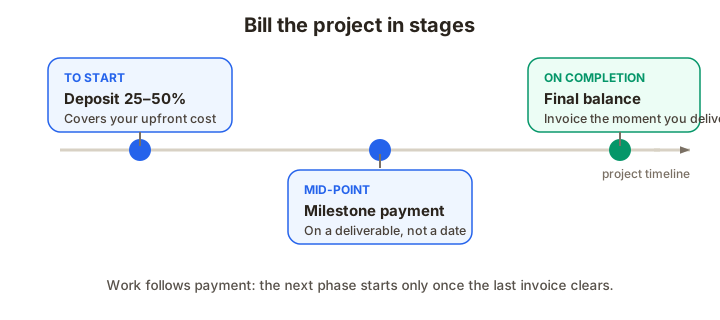
A clean three-payment structure for a typical project: deposit to start, a payment at the major mid-point deliverable, balance on completion — with the final invoice sent the moment you deliver, while the client is still in the headspace of having just received the work.
The leverage rule: work follows payment
The most important habit in milestone billing is also the simplest: don't begin the next phase until the current invoice is paid. It's the natural shape of staged work, where each payment unlocks the next block of effort.
The practical reason: it is far easier to hold work you haven't started yet than to recover money for work you've already delivered. Once you've handed over the final files, your only tools are follow-up emails and, eventually, collections. Before you start a phase, your tool is simply not starting it. Build the schedule so that at no point have you delivered substantially more than you've been paid for, and most non-payment problems never get the chance to escalate. For the ones that still do, see how to handle a client who won't pay.
Deposits and refunds: get the wording right
A deposit invites one predictable question when a project goes sideways: is it refundable? Decide the answer before you take the money, and write it down.
A deposit framed as payment for the time and resources you commit up front is generally more defensible as non-refundable than one that reads like a cancellation penalty. You're not punishing the client for leaving — you're keeping payment for work and time already committed. Put it in the contract in plain language: "The deposit secures your project slot and the initial work; it is non-refundable once work begins." Don't bury it in legalese.
A couple of caveats: consumer-protection law varies by state and country, and some places limit non-refundable deposits or require specific disclosure. Whatever you decide, the deposit terms belong in the signed agreement, not invented after a dispute starts.
Progress billing and retainage in construction
If you work in the trades, progress payments may be billed against percentage of completion using forms such as AIA G702/G703. Some contracts also hold back retainage until a defined completion point; the permitted amount and release rules vary.
Retainage protects the buyer, but it delays a meaningful slice of your cash, so price for it and track it. The accumulated retainage is money you're owed; it just isn't payable until closeout. Many contractors lose track of it and forget to invoice for it at the end. Don't be one of them.
Putting it on the invoice
Each milestone gets its own invoice, referencing the original quote or contract so the client can see the whole arc. Show what's been paid and what remains: a line such as "Milestone 2 of 4: design approved · paid to date $2,500 · balance after this invoice $5,000" answers the question before the client asks it. Keep invoice numbers sequential, terms short, and a pay link on every one so each stage clears quickly.
If the scope changes mid-project (and on real projects it often does) handle it as a change order rather than quietly absorbing it; see change orders: adjusting a quoted price.
Start a staged invoice
Issueable lets you reference the accepted quote, itemize the current milestone, add prior-payment context in the notes, and include a payment link. Create your deposit or milestone invoice and verify the remaining balance against your accounting records before sending.
Frequently asked questions
- How much should I ask for as a deposit?
- Base the deposit on your actual exposure before the next payment: non-returnable materials, reserved time, and early labor. A percentage can make the schedule easy to understand, but there is no universal band. Custom work may justify more protection, while a long engagement can spread risk across several milestones.
- What's the difference between a deposit and a retainer?
- A deposit is an upfront payment against a specific project, credited toward the final total. A retainer is a recurring fee that reserves your availability or a block of hours over a period, closer to a subscription. If you're billing the same client every month for ongoing work, you want a retainer, not a series of deposits. See our guide on recurring invoices for that structure.
- Should milestones be tied to dates or deliverables?
- Use a trigger both parties can verify. Deliverables work well for fixed projects; calendar milestones can suit retainers, construction progress billing, and ongoing services. Define what completion or approval means so the client cannot delay a payment simply by withholding feedback.
- Can I make a deposit non-refundable?
- Often, but not always, and the wording matters. A deposit framed as payment for time and resources you commit up front is generally more defensible as non-refundable than one that looks like a penalty for cancelling. Consumer-protection law varies by state and country, and some jurisdictions limit non-refundable deposits or require specific disclosures. Put the term in the contract in plain language, and confirm what's enforceable where you operate.
- What is retainage in construction billing?
- Retainage (or retention) is an agreed portion of progress payments held until a defined completion or acceptance point. The percentage, release conditions, and legal limits vary by contract and jurisdiction. Track it separately and follow the notice and closeout process needed to collect it.
- How do I invoice each milestone?
- Issue a separate invoice for each milestone as it's reached, referencing the original quote or contract and showing what's been paid and what remains. A line like 'Milestone 2 of 4: design approved (paid to date: $2,500; balance after this invoice: $5,000)' tells the client exactly where they are. Keep the numbering sequential and the terms short.