How to Handle a Client Who Won't Pay: Step-by-Step Playbook
The Issueable Team
Small business operations
When a client stops paying, louder demands rarely help. A structured escalation does. Here's the playbook from friendly reminder through small claims, with scripts at every stage.
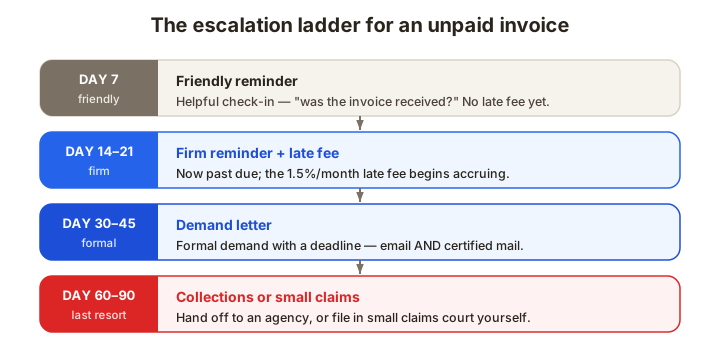
When a client won't pay: the first 7 days
Faced with a client who won't pay — or just hasn't yet — the first instinct is panic, followed by a nervous email at day 1 or 2 past due. Resist it.
In B2B environments, invoices land in AP cycles that fire on specific days of the month, not on the day after they're due. A net-30 invoice issued April 5 might technically be due May 5, but it'll actually pay in the next AP run — which could be May 10 or May 15 depending on the client's cycle. A "where's my payment?" email at day 2 just makes you look impatient.
Wait until day 7 past due. At that point, AP cycle delays are exhausted, and either there's a real problem or someone forgot.
Day 7: the friendly reminder
Keep the tone helpful and neutral. The buyer's AP person is rarely the project manager who hired you — treat this as a coordination issue.
Subject: Invoice INV-1042: quick check

Hi [name],

Hope you're well. Just checking in on invoice INV-1042 from
April 5; it came due last week and I want to confirm the
payment is in motion.

Total: $4,200 (net-30 from issue date)
Original invoice: [link or attached]

If there's anything I can help clarify on the AP side, just
let me know. Otherwise, if it's already in motion, ignore
this and have a great week.

Thanks,
[your name]
Many invoices that hit this stage clear within a few business days: the AP person sees the reminder, finds the invoice, and processes it.
Day 14-21: the firm reminder
If the friendly reminder didn't trigger payment, send a firmer one. Now it's not "AP cycle delay"; it's a real issue. The tone shifts: still professional, still neutral, but specific about consequences.
Subject: Invoice INV-1042: past due, late fees beginning

Hi [name],

Following up on invoice INV-1042. The invoice is now 14 days
past due. Per the terms on the original invoice, a late fee
may now apply if your contract allows it.

Total now due: $4,263 ($4,200 principal + $63 late fee)
Original invoice: [link]
Payment due by: [date 7-10 days out]

If there's an issue with the work or a question about the
invoice, please let me know directly so I can address it.
Otherwise I'd appreciate confirmation that payment is on its
way.

Thanks,
[your name]
The shift from "checking in" to "late fees beginning" changes the dynamic. AP teams don't love extra charges, so a clear late-fee notice often gets attention inside the buyer's organization.
Day 30-45: the demand letter
If the firm reminder didn't work, you're in genuine collections territory. Send a demand letter. This is more formal: written like a legal document, not an email.
[Your business name]
[Address]
[Date]

[Client business name]
[Address]

Re: Demand for payment: Invoice INV-1042

This letter constitutes a formal demand for payment of past-
due invoice INV-1042, originally issued April 5, 2026, in
the amount of $4,200, plus accrued late fees as of this date.

Total now due: $4,326
- Principal: $4,200
- Late fees (1.5%/mo x 2 months): $126

Payment must be received by [date 10-14 days out]. If payment
is not received by that date, we may pursue the remedies
available under our agreement and applicable law, including
[a named next step you are genuinely prepared to take].

Sincerely,
[your name]
[business name]
Send notice by the methods required in the contract and governing law. Email, tracked mail, a contractual notice address, or formal service can have different legal effects; a delivery receipt proves delivery activity, not that every legal notice requirement was satisfied.
The demand letter often works because it shifts the matter from "freelancer billing dispute" to "potential legal action." The buyer's CFO or owner gets involved at this stage, and paying is usually the path of least resistance.
Day 60-90: collections or court
If the demand letter didn't trigger payment, you have two common options.
Collections agency. Ask about licensing, fees, authority to settle, reporting practices, dispute handling, and who controls litigation. Federal FDCPA protections generally cover consumer rather than business debts, but state laws and other rules may still govern the agency's conduct.
Small claims court. Eligibility, dollar limits, venue, service, attorney participation, filing fees, and appeal rules vary by jurisdiction. A judgment also does not guarantee collection. Read the current court instructions before choosing this route.
Compare the claim amount with filing and service costs, time, evidence, likely defenses, collection-agency quotes, limitation periods, and whether the debtor has reachable assets. No single invoice range makes small claims the better path everywhere.
For a material or legally disputed amount, an attorney can assess venue, claims, defenses, limitation periods, fee-shifting terms, and collectability. Get an actual fee quote rather than relying on a generic demand-letter price or promised success rate.
When the dispute is real
Sometimes the buyer isn't refusing to pay — they're disputing whether the work was complete, whether it met the scope, or whether the deliverables matched the engagement letter. That's a genuinely different problem.
In that situation, stop pushing for full payment and start exploring settlement. A negotiated partial recovery on a disputed invoice usually beats a long court fight that may never collect. Document everything carefully: emails, signed engagement letters, deliverables checklists, acceptance criteria from the SOW. These become evidence either way the matter resolves.
The settlement script:
Hi [name],

I want to find a path forward on invoice INV-1042. I understand
[their concern] and I'd like to propose: I'll accept $X
(70% of the invoice) as settlement in full, in exchange for
treating the matter as closed. This is well below my cost on
the engagement, but I value the relationship and want to
move on cleanly.

Would that work for you?

Thanks,
[your name]
Most disputes resolve here. The buyer is happy to pay something rather than nothing; you're happy to recover the bulk of your work without the stress of court.
Walking away
There's a class of invoice where pursuit is genuinely not worth it:
- The likely recovery is lower than the time and out-of-pocket cost of pursuit
- The buyer has gone bankrupt or out of business
- The buyer has moved jurisdictions and you can't enforce
- The dispute is genuine and deep, with mixed evidence
Write the invoice off. Take the lesson. Apply it to the next engagement: typically by requiring a deposit, structuring milestone payments, or vetting clients more carefully before signing.
Prevention is the actual answer
Every collections case is also a deposit case in retrospect. The clients who become collections problems often showed early signals — resistance to deposits, pushback on milestone billing, vague answers to scope questions, slow response times. Those signals are worth trusting.
Some habits that help:
- Use a deposit or milestone payment when the risk warrants it. State the amount, refund terms, and cancellation treatment in the contract, and check local rules before describing any payment as non-refundable.
- Milestone billing for engagements over 4 weeks. "All at the end" is the riskiest possible structure.
- Engagement letters in writing with payment terms, late fees, and dispute-resolution language. The friction of getting one signed weeds out the worst clients before work starts.
Issueable's small business invoice template and late-fee calculator handle the document side. The discipline (deposits, milestones, written agreements) is yours.
If you're at the front end of a difficult engagement and want to bake the right late-fee structure in from the start, see our late fees on invoices article for state-by-state rules.
Frequently asked questions
- When should I escalate from a friendly reminder to a formal demand?
- A common cadence is a friendly reminder around 7 days past due, a firmer reminder around 14 days, a demand letter around 30 days, and collections or legal action later if needed. The exact timing matters less than the consistency. If you escalate predictably, clients learn that you're organized and prioritize your invoices.
- Should I add a late fee at the first reminder or wait?
- Wait. The first reminder should be friendly: "Just checking in, invoice INV-1042 came due last week. Was it received?" Adding a late fee at the first contact reads as aggressive and damages the relationship. Add the late fee with a later formal reminder if your contract allows one. The late fee belongs on the formal escalation, not the friendly check-in.
- What goes in a demand letter?
- Five elements: (1) the original invoice number, date, and amount; (2) a clear statement that the invoice is past due; (3) the total amount now owed including any late fees; (4) a payment deadline; (5) a clear next step if payment isn't received ("this matter will be referred to collections" or "we will pursue this through small claims court"). Sending it by email and, if you want a paper trail, certified mail can help document notice.
- Should I send to collections or go straight to court?
- Depends on the amount and the relationship. For smaller invoices, small claims court is often the simplest path; for larger ones, an attorney's demand letter can add weight. Between the two, it's a judgment call based on your documentation, the likely recovery, and whether you already have legal help.
- What if the client disputes the work?
- Different problem entirely; that's a dispute resolution case, not a collections case. If the client claims you didn't deliver what was promised, document carefully: signed engagement letter, deliverables list, communications confirming acceptance. Many disputes resolve through negotiated settlement rather than court. Stop pushing for full payment and start exploring a fair compromise if the work itself is being challenged.
- When should I just write it off?
- When pursuit will cost more than recovery. For very small invoices, the time you'd spend chasing usually isn't worth it. For invoices where the client has gone bankrupt, moved jurisdictions, or simply disappeared, the recovery odds are slim. Write off as bad debt if appropriate for your accounting method, then apply the lesson to the next client.
- How do I prevent this from happening again?
- Three habits: (1) a deposit on signing for new clients when the project has meaningful size or risk; (2) milestone billing on longer engagements rather than "all at the end"; (3) clear engagement letters with payment terms, late fees, and dispute-resolution procedures spelled out in writing. Clients who push back hard on payment structure early often become harder to collect from later.
- Should I leave a public review or warn other freelancers?
- Tempting, but be careful. Public statements about a client's payment behavior can be defamatory if not factually accurate, and "clients who don't pay" lists circulating in freelancer communities have led to lawsuits. Stick to factual, neutral information shared privately with people you actually know. Better: leave a structured review on platforms with verification (Upwork, Clutch, Trustpilot).