Receipt vs Invoice: The Difference and When You Need Both
The Issueable Team
Small business operations
A receipt confirms payment has been made; an invoice requests payment. Learn when you need both, how they work together, and how to use them in your workflow.
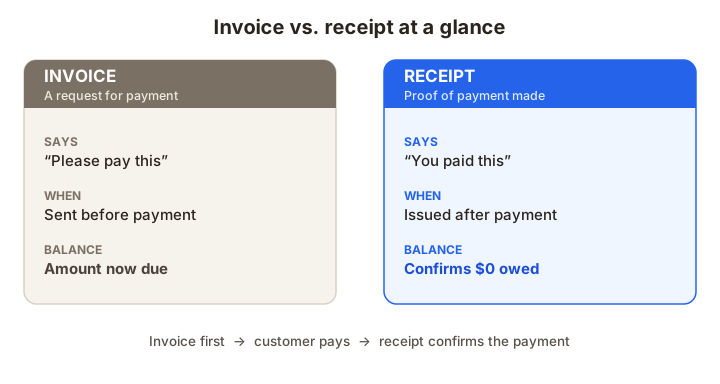
Receipt vs. invoice: the core difference
The difference is simple but easy to muddle in practice:
- An invoice is a request for payment. You've provided a service or product, and now you're asking the buyer to pay. Invoices are sent before payment.
- A receipt is proof that payment has been made. The transaction is complete. Receipts are issued after payment.
In a typical B2B workflow, the invoice comes first (asking for payment), and the receipt comes later (confirming payment was received). For retail or e-commerce, the receipt is issued immediately at the point of sale (because payment is immediate).
When you need only a receipt
You need only a receipt in these cases:
- Point-of-sale retail. A customer buys a product, pays immediately, and walks out with a receipt. No invoice needed.
- E-commerce. A customer buys online, pays by card, and receives an instant receipt (or "order confirmation"). The receipt is the only document they need.
- Small cash or check transactions. A customer pays $200 in cash for a one-off service. You hand them a receipt; the transaction is done.
- Subscription or SaaS. Many subscriptions send a receipt each billing cycle to show that the payment was processed. No separate invoice is sent.
In these cases, a single receipt handles both: it acknowledges the sale and confirms payment.
When you need both an invoice and a receipt
You need both documents when payment is delayed or when you're invoicing for work that will be done later:
- Project work with Net 30 terms. You send an invoice when you complete the work ("You owe me $10,000 by May 31"). The customer pays on May 25. You send a receipt ("Payment received May 25, balance due $0"). The invoice and receipt create a complete record.
- Retainers. You invoice on the first of each month for the retainer fee ("Retainer for May: $5,000, due May 31"). The customer pays on May 25. You send a receipt confirming the May payment was received.
- Deposits and final payment. A customer places a $10,000 order. You send an invoice for a 50% deposit ($5,000, due on receipt). They pay. You send a receipt for the deposit. Later, you invoice for the remaining 50% ($5,000, due on delivery). They pay again. You send a receipt for the final payment. Two invoices, two receipts.
- B2B or government contracts. Formal purchase orders trigger formal invoices, and payment is confirmed with formal receipts. The buyer's accounting system requires both.
Practical example: a design project
Here's how invoices and receipts work together on a typical project:
Day 1: Client approves the design scope. You send a quote for $5,000 (50% deposit, 50% on delivery).
Day 2: Client accepts the quote. You send an invoice for $2,500 (deposit) due immediately.
Day 2 (later): Client pays $2,500 by bank transfer. You send a receipt confirming the deposit was received. The balance due is now $2,500.
Day 15: You deliver the final design. You send an invoice for $2,500 (final payment, due Net 30).
Day 25: Client pays $2,500. You send a receipt confirming the final payment was received. The project is fully paid.
Each invoice is matched to a receipt once payment clears — the two documents travel together through the project.
What goes on a receipt
A receipt should include:
| Field | Required? | Example |
|---|---|---|
| Receipt number | Yes | RCP-001, RCP-002, etc. (for your records) |
| Date | Yes | May 20, 2026 |
| Your business info | Yes | Sarah Chen Design, sarah@example.com |
| Customer name | Yes | ABC Corp |
| Amount paid | Yes | $2,500.00 |
| Payment method | Yes | Bank transfer, check, card, cash |
| Description of service/product | Yes | "Design retainer for May" or "Invoice INV-0042 payment" |
| Invoice number (if applicable) | Recommended | "Payment for Invoice INV-0042" |
| Memo or note | Optional | "Thank you!" or "Balance due $2,500" |
For receipts tied to an invoice, always reference the original invoice number. This helps the customer match the payment to the original request.
Receipts for different payment types
Cash payment receipt:
Include the amount in words and numerals to prevent disputes. "Five thousand dollars ($5,000.00)". Add who received the payment (name and signature). Many businesses keep carbon-copy receipt pads for cash; customers keep one, you keep one.
Check payment receipt:
Include the check number (e.g., "Check #4821"). This helps the customer reconcile the payment if the check gets lost in transit.
Bank transfer receipt:
Include the transaction ID or confirmation number if available (many banks provide this). This ties the receipt to the actual bank record.
Card payment receipt:
Include the last four digits of the card ("Visa ending in 4921") and the authorization code. This is critical if there's a dispute later; you can trace it to the actual credit card transaction.
The tax angle: does a receipt need to show sales tax?
If you're collecting sales tax or GST/HST, yes. Show on the receipt:
- What was charged (e.g., "$5,000 for design services")
- Tax rate and amount ("Tax 9.375%: $468.75")
- Total paid ("Total: $5,468.75")
This matches the tax you showed on the original invoice and is your record for sales-tax filings.
The accounting angle: invoices and receipts as records
From an accounting perspective:
- The invoice records that you provided a service or product and are owed money — "accounts receivable" in your books.
- The receipt is your proof that the customer paid. It reduces the accounts-receivable balance and increases cash.
Together, they create a complete transaction record: work was done, payment was requested, and payment was received.
When a customer asks for a receipt but you haven't issued an invoice
Some customers want a receipt immediately without an invoice. This is common with small transactions or when they're paying upfront.
In this case, a receipt is sufficient. It serves as both the transaction record and the proof of payment. You can include a line like "Payment in full for [service name]" to make clear that the balance is zero.
Digital vs. printed receipts
- Digital receipts. Email a PDF receipt to the customer immediately. Keeps things fast and paperless.
- Printed receipts. For in-person transactions, a printed receipt is standard. But follow up with an emailed PDF for the customer's records.
- Auto-generated receipts. E-commerce and SaaS platforms auto-generate receipts on payment. Make sure your platform is sending them; if not, you may need to add a manual step.
Receipt retention for audits
Keep retrievable copies of records that support income, deductions, credits, and tax collected. The IRS retention period depends on the event and limitation period: three years is common, but longer and indefinite periods apply in specified cases. CRA retention rules also depend on the record and tax regime. Use the applicable agency guidance instead of one global six-to-seven-year rule.
The document workflow for larger projects
For a project with a deposit and a final payment, you may end up with several documents:
- Quote. A $10,000 project. "Quote: $10,000, due upon acceptance."
- Invoice for deposit. Customer accepts. You send Invoice-1 for $5,000 (50% deposit, due immediately).
- Receipt for deposit. Customer pays $5,000. You send Receipt-1 confirming the $5,000 payment and noting the remaining balance ($5,000 due on delivery).
- Invoice for final payment. You deliver. You send Invoice-2 for $5,000 (final payment, due Net 30).
- Receipt for final payment. Customer pays $5,000. You send Receipt-2 confirming the final $5,000 payment and noting the project balance is $0.
Five documents for one project might feel like overkill, but it creates a complete transaction trail that's clean for both you and the customer's accounting. Each document has a specific job.
When to skip a document
For very small transactions (under $100), a single receipt is enough — no invoice needed. It serves as both the order record and the proof of payment.
For retainers or subscriptions, one invoice per billing period and one receipt per payment is the right rhythm: simple, recurring, easy to reconcile.
Digital receipts and compliance
If you collect GST/HST, sales tax, or VAT, tax authorities can ask for copies of the receipts you issued, not just the ones you received — the retention windows above apply to both.
For e-commerce, many jurisdictions require that receipts be available to customers either by email or download. If you're using Stripe, PayPal, or Shopify, they auto-generate receipts. Make sure they're enabled.
Ready to send receipts and invoices?
Issueable's receipt maker generates professional receipts in seconds, and links to the invoice generator so you can track the full transaction from request to payment. Start now.
Frequently asked questions
- Is a receipt the same thing as an invoice?
- No. An invoice is a request for payment ('please pay this by May 31'). A receipt is proof that payment was made ('you paid $5,000 on May 20'). Invoices come before payment; receipts come after. For small transactions (retail, e-commerce), the receipt is the only document you need. For bigger projects, you send an invoice first, then a receipt once paid.
- Do I legally need to provide a receipt?
- It depends on the jurisdiction, transaction, payment method, and industry. Tax, consumer-protection, rental, and card-network rules can impose different documentation duties. Check the rule that applies rather than assuming invoiced work is exempt; even when optional, a paid receipt is useful evidence.
- Can I use a receipt as an invoice?
- Not really. A receipt says 'you paid this,' while an invoice says 'you owe this.' If you give a customer a receipt before they've paid, they'll be confused about whether they still owe you money. For clarity, use an invoice first, then a receipt once payment clears.
- What should be on a receipt?
- Date, amount paid, payment method (cash, check, card, bank transfer), your business name and address, description of what was paid for, and a receipt number (for your records). If you collected sales tax, show the amount. Include any relevant order or invoice number so the customer can match it to their records.
- Should I send a receipt immediately after payment?
- Send it promptly after the payment is confirmed. Card processors may generate one automatically; checks and bank transfers should not be marked paid before they clear. For recurring payments, issue a receipt for the actual charge date rather than an arbitrary calendar date.
- What if a customer asks for a receipt but paid by invoice (30 days later)?
- Send them a receipt showing the payment date and amount. The receipt confirms that the balance on the original invoice is now $0. Reference the original invoice number so they can match it in their accounting system.