Sales Tax on Invoices: 2026 US State-by-State Guide
The Issueable Team
Small business operations
What changed after South Dakota v. Wayfair, what economic nexus means in practice, and how to put the right tax line on every invoice, from a one-state freelancer to a multi-state SaaS company.
Why sales tax on invoices is suddenly complicated
Until 2018, sales-tax collection in the US worked on a roughly two-century-old rule: a state could only require you to collect tax if you had a "physical presence" there: a store, an office, employees, inventory. If you sold from California to a customer in Texas without ever setting foot in Texas, no collection obligation.
That changed with South Dakota v. Wayfair, Inc., decided by the Supreme Court in June 2018. The Court ruled that physical presence was no longer required; states could require out-of-state sellers to collect sales tax based on economic activity (sales volume or transaction count) inside the state. Since then, most states with a sales tax have adopted economic-nexus rules and marketplace-facilitator rules.
The result: a freelancer or small business that ships physical goods or sells SaaS can now face collection obligations in dozens of states simultaneously. The rules are surprisingly mechanical once you understand them — which makes getting this right more about tracking than legal expertise.
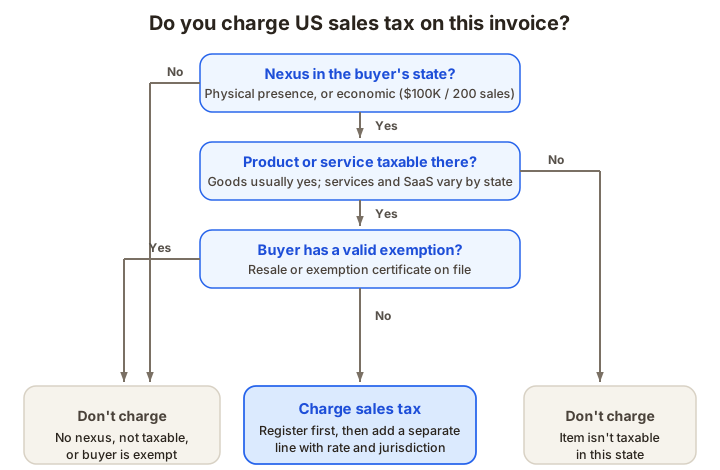
Step 1: Find out where you have nexus
Sales-tax nexus is a legal connection between your business and a state. Nexus can create a duty to register and collect, but the final answer also depends on taxability, sourcing, exemptions, and whether a marketplace facilitator is responsible for the transaction. Nexus usually comes from two broad sources:
- Physical presence. Office, employees, inventory in a warehouse (including third-party 3PL warehouses), trade-show attendance, or a remote employee working from that state.
- Economic nexus. Enough sales or transactions into the state to cross that state's activity threshold. The threshold can be a sales amount, a transaction count, or both, and it changes by state.
Rather than memorizing every threshold, check the current rule with the state's revenue department or a current tax engine before you start collecting.
Step 2: Find out what's taxable
Even if you have nexus, you don't necessarily collect; you only collect on taxable products and services. Three patterns matter:
Goods. States with a sales tax commonly tax retail sales of tangible personal property, but definitions, exemptions, holidays, and local rules vary. Check the product's classification in the states where you have an obligation to collect.
Services. Mostly not taxable, with major exceptions. Some states tax most services by default, while others tax only specific categories such as repair, lodging, telecommunications, or digital services. If you bill professional services (consulting, design, accounting, legal), the default in many states is non-taxable, but check.
Digital products and SaaS. This is where the rules diverge most sharply. Some states tax SaaS under their computer-services or digital-goods rules, and some do not tax it at all. SaaS sellers should re-verify state by state every year.
Step 3: Register where required
If you have nexus in a state and make taxable sales for which no facilitator collects, determine when that state requires registration. Do not collect tax before you have the registration or authority the state requires.
Registration is generally:
- Online, through the state revenue department portal.
- Tied to a filing cadence, assigned by the state based on expected volume.
The Streamlined Sales Tax (SST) registration is a single registration that can simplify multi-state registration if you're working across member states.
Step 4: Apply the right rate
Once registered, you collect at the rate that applies under that state's sourcing rules. For remote sellers, destination sourcing is common, which means the rate at the buyer's location. Combined rates can include state, county, city, and special-district layers, so using a current lookup or tax engine is safer than hard-coding a rate table.
Step 5: Show tax correctly on the invoice
Sales tax on an invoice should appear as a separate line, not hidden inside the price. A clean format:
Web design: Brand strategy workshop, May 14    $1,000.00
Web design: Wireframes, June 1–10               1,500.00
                                  Subtotal      $2,500.00

Sales tax (example rate: 8%)                       200.00

                                  Total         $2,700.00
Three formatting rules:
- Show the rate and jurisdiction. "Sales tax (example rate: 8%)" is more useful than a tax amount with no context.
- Itemize multi-jurisdiction taxes if the buyer's state requires it. Some systems use a combined rate; others show the components separately.
- Follow the jurisdiction's rounding rule. Tax software may calculate by line or on the taxable subtotal, and the two methods can differ by a cent.
Resale certificates and exempt buyers
Some buyers don't pay sales tax even on taxable goods or services:
- Resellers who buy for resale (a wholesaler buying from you to sell to retail). They give you a resale certificate with their reseller ID; you keep it on file and don't charge tax. The certificate is your defense if the state audits and asks why you didn't collect.
- Tax-exempt entities, which may include government agencies, qualifying nonprofits, and educational institutions depending on the state. They provide the exemption documentation that state requires.
- Manufacturers who buy components for incorporation into a finished product. State-specific rules apply.
Collect the certificate as part of the sale whenever possible and keep it with your records. Rules for accepting late or corrected certificates vary by state.
Marketplace facilitators: the silent tax payer
If you sell on Amazon, Etsy, eBay, Walmart Marketplace, DoorDash, Airbnb, or any similar platform, the marketplace itself is generally responsible for collecting and remitting sales tax, not you. This is generally true in states with a sales tax.
What this means in practice:
- Confirm which marketplace sales the platform covers. Facilitator laws commonly put collection on the platform, but scope and exceptions vary.
- Your invoice from the marketplace shows tax as a line item that the platform handled.
- Marketplace sales still count toward your nexus thresholds in some states (the rule varies; check). So even if you don't owe collection on those sales, they may push you over the threshold for direct sales.
If you sell both through marketplaces and directly (your own website, invoiced services), keep separate ledgers. Direct sales are still your responsibility.
State-by-state cheat sheet (sales-tax compliance posture)
Rather than memorizing every threshold, group states into three buckets:
- No statewide sales tax, where local taxes may still exist.
- Lower-complexity states with a single main filing and straightforward sourcing.
- Higher-complexity states with lots of local variation, district taxes, or frequent rule changes.
If you have nexus in a higher-complexity state and you don't already use a tax engine, that's a good place to start.
Common mistakes to avoid
- Collecting without the required registration or authority. This can create filing, remittance, refund, and penalty problems even if the rate itself was correct.
- Not registering before collecting. Some states impose penalties for collecting tax without a permit.
- Ignoring a filing notice because sales were zero. Many active permits still require a zero return, but the filing obligation depends on the state and the status of the account.
- Bundling tax into the price. Most states are easier to reconcile when tax is shown separately on the invoice or receipt.
- Treating SaaS as universally non-taxable. It isn't. Re-check every year.
A 7-line sales-tax checklist before you send any invoice
- Buyer's state and zip on file
- You're registered to collect in that state (if required)
- Product/service is confirmed taxable in that state
- Rate is current (pulled within the last quarter)
- Tax shown as a separate line with rate and jurisdiction
- Resale or exemption certificate on file (if buyer is exempt)
- Total = subtotal + tax, exactly
Ready to send a tax-correct invoice?
Issueable's invoice generator supports two document-level tax rates with custom labels. It does not assign taxability by line item or look up state and local rates, so calculate the taxable base and combined rates under the applicable jurisdiction's rules before sending. Create an invoice.
Frequently asked questions
- Do I need to charge sales tax on every invoice?
- No. A seller's collection duty generally depends on nexus, registration, the taxability and sourcing of the sale, and any exemption. Marketplace-facilitator rules may put collection on the platform instead. Check the current rule in each state where you have physical or economic activity.
- What is economic nexus and how do I know if I have it?
- Economic nexus is the rule, established by South Dakota v. Wayfair in 2018, that says a state can require an out-of-state seller to collect sales tax once that seller crosses that state's activity threshold, even with no physical presence. The exact threshold and registration timing vary by state, so track sales by state monthly and confirm the current rule with the state revenue department before you start collecting.
- Are services taxable, or only goods?
- It depends entirely on the state. Some states tax most services by default, others tax only specific categories, and SaaS sits in its own gray zone. Check the current rules in every state where you have nexus, because service taxability changes and the details matter.
- What is a marketplace facilitator and why does it matter?
- A marketplace facilitator is a platform that processes transactions on behalf of third-party sellers: Amazon, eBay, Etsy, DoorDash, Airbnb, etc. In many states, marketplace-facilitator laws require the platform, not the underlying seller, to collect and remit sales tax for marketplace transactions. If you sell exclusively through a marketplace, your direct collection burden is usually lighter, but your own website and invoiced services can still count toward nexus.
- How do I show sales tax on an invoice?
- Show the subtotal, then a separate sales-tax line with the applicable rate and amount, then the total. For example: 'Subtotal: $1,000.00 / Sales tax (8%): $80.00 / Total: $1,080.00.' If local rules call for multiple tax lines, break them out so the buyer can see how the total was assembled.
- What if I'm a freelancer in a state with no sales tax?
- If you live in a state without a statewide sales tax, you may have no in-state collection obligation, but you can still trigger nexus and a collection obligation in any other state where you do business. Some no-tax states still have local taxes, so check both the state and local rules.