Pro Forma Invoice vs Commercial Invoice: When to Send Each
The Issueable Team
Small business operations
A pro forma invoice describes a proposed transaction; a commercial invoice records the actual shipment or sale and may support payment and customs. Learn where each fits.
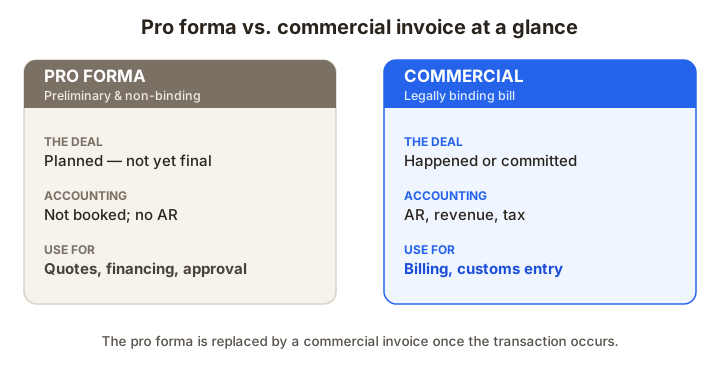
The two documents serve different jobs
A pro forma invoice is a preliminary document describing a proposed transaction that has not yet been finalized or shipped. It should be labeled clearly and use a reference distinct from the final invoice sequence. Businesses use it for internal approval, financing discussions, and pre-shipment planning. Its label does not make its terms legally harmless: sufficiently definite terms and acceptance can still matter under the governing law.
A commercial invoice records the actual sale or shipment. Depending on the workflow, it may:
- Support the seller's receivable and the buyer's payable.
- Provide customs with transaction-value and goods information.
- Support tax and accounting records alongside the contract, shipping, and payment evidence.
The two documents can look nearly identical. The useful distinction is purpose: the pro forma describes what is proposed; the commercial invoice documents what was actually sold or shipped.
When to send a pro forma invoice
Pre-shipment customs planning. A carrier, broker, or buyer may request transaction details before goods move. A pro forma can provide descriptions, estimated value, origin, and delivery terms, but the broker decides whether it is sufficient for a particular filing. The final shipment should carry the invoice documentation the destination and carrier require.
Financing and letters of credit. When a buyer needs bank financing to make a purchase — particularly an import letter of credit — the bank requires documentary evidence of the deal terms before issuing credit. A pro forma invoice serves as that evidence. The bank structures the L/C to release payment when the eventual commercial invoice and shipping documents match the pro forma.
Internal purchase approval. Larger buyers have multi-step procurement approval workflows. The buyer's procurement team needs something to circulate to finance, legal, and the line-of-business approver before issuing a purchase order. A pro forma invoice fills that gap; it gives them the deal terms in a recognizable format without committing either party.
What pro formas should not do:
- Masquerade as the final invoice. If payment is due, use the document and numbering workflow the agreement and accounting system require.
- Be posted automatically as a receivable. A preliminary pro forma normally belongs outside accounts receivable.
- Be assumed sufficient for customs. A broker or customs authority may accept substitute documentation in some circumstances, but requirements vary by entry.
What a pro forma invoice should contain
Most of the same fields as a commercial invoice, with a few flags:
- "Pro Forma Invoice" prominently in the header. Don't make the buyer guess.
- Reference number that signals it's a pro forma (e.g., "PF-2026-042" or "Quote #..."). Don't use your sequential invoice numbering.
- Issue date and validity period. "This pro forma is valid through [date]." Without a validity window, the buyer can come back six months later expecting the same prices.
- Seller and buyer details. Same as a commercial invoice.
- Detailed goods or services. Specific enough that the buyer can plan around it. For physical goods, include HS classification numbers when known.
- Quantities and unit prices.
- Total in the currency of sale.
- Estimated shipping costs and agreed delivery term. If the parties use Incoterms, include the named place and version.
- Estimated taxes or duties. If you know they'll apply.
- Estimated lead time or ship date.
- A note that it is not a request for payment. "This pro forma invoice is provided for planning purposes only and does not constitute a request for payment or a binding offer."
What a commercial invoice should contain
For a domestic invoice, the standard fields apply: business and bill-to information, invoice number, dates, line items, taxes, total, payment terms (covered in detail in What to put on an invoice).
For an international commercial invoice, customs and carrier requirements add shipment-specific fields. For goods entering the United States, 19 CFR § 141.86 lists invoice contents and product-specific details. Other destinations have their own rules, so use this as a working list and confirm it with the carrier or broker:
- Names and addresses of seller and buyer (importer and exporter).
- Port of entry.
- Detailed description of the goods. Generic descriptions ("electronic parts") will get the entry held; specific descriptions ("printed circuit boards, model PCB-200, for industrial humidity sensors") clear cleanly.
- HS or national tariff classification, when required or confirmed. The first six HS digits are internationally harmonized; national schedules add digits. The importer or broker should confirm the final classification.
- Quantity in the unit appropriate for the goods.
- Unit price and total price in the transaction currency.
- All charges and rebates affecting the value: freight, insurance, packing, commissions, royalties.
- Country of origin. Where the goods were manufactured, not where they shipped from.
- Currency of sale.
- Incoterm (e.g., "FOB Shanghai (Incoterms 2020)").
- Date of sale and date of shipment.
- Any rebates, drawbacks, or bounties allowed on the goods.
A vague or incomplete invoice can delay clearance and add storage or broker costs. Specific descriptions and internally consistent values make review easier, but the exact required fields come from the destination, goods, carrier, and entry type.
Incoterms 2020 in practice
Incoterms are three-letter codes published by the International Chamber of Commerce that allocate responsibility for the various costs and risks in an international shipment. Always reference the version (Incoterms 2020 is current as of 2026). The eleven 2020 terms split into two groups:
Any mode of transport (most common for general goods):
- EXW (Ex Works). Buyer takes possession at seller's location. Buyer handles all transport, export, import, and customs.
- FCA (Free Carrier). Seller delivers to a named carrier. Common for container shipping when the seller wants out before the port.
- CPT (Carriage Paid To). Seller pays freight to named destination. Risk transfers to buyer when goods are handed to first carrier.
- CIP (Carriage and Insurance Paid To). Same as CPT plus insurance. Often used for high-value cargo.
- DAP (Delivered at Place). Seller delivers to a named destination, ready for unloading.
- DPU (Delivered at Place Unloaded). Seller delivers and unloads at destination.
- DDP (Delivered Duty Paid). Seller delivers fully customs-cleared and duty-paid to the buyer's place.
Sea and inland waterway only:
- FAS (Free Alongside Ship). Seller delivers alongside vessel at named port.
- FOB (Free On Board). Seller delivers the goods loaded on board the vessel. Risk transfers once they're on board (the old "ship's rail" wording was dropped in Incoterms 2010).
- CFR (Cost and Freight). Seller pays freight to named destination port. Risk transfers at origin.
- CIF (Cost, Insurance, and Freight). Same as CFR plus insurance.
A common mistake: using FOB for non-sea shipments (containers shipped by truck or air). FOB only applies to vessel transport. For containers, use FCA.
A short worked example
Consider a Canadian electronics distributor selling industrial sensors to a US importer.
Pro forma stage (60 days before shipment): the buyer's bank requires a pro forma to issue a $250,000 letter of credit. The seller issues:
Pro Forma Invoice PF-2026-014 Date: May 1, 2026 · Valid through July 31, 2026 Seller: Sensor Co. Ltd, 123 Main St, Toronto, ON Buyer: USA Industrial Inc, 200 Park Ave, New York, NY Description: Industrial humidity sensor, model HS-200, 1,000 units HS code: 9025.80 Unit price: USD 250.00; Total: USD 250,000.00 Incoterms: CIP New York (Incoterms 2020) Estimated shipping: July 1, 2026 Country of origin: Canada Note: This pro forma is for planning and L/C structuring purposes only.
Commercial invoice stage (day of shipment, July 5, 2026): the actual deal has happened. Same parties, same goods, but now the document drives customs and accounting:
Commercial Invoice INV-2026-187 Issue date: July 5, 2026 · Due: August 4, 2026 (Net 30) Reference: PO 88421; L/C 9988-7654 (Bank of X) Seller: Sensor Co. Ltd, 123 Main St, Toronto, ON, Canada · GST 12345-6789 Buyer: USA Industrial Inc, 200 Park Ave, New York, NY 10166 · EIN 12-3456789 Port of entry: Newark, NJ Goods: 1,000 × Industrial humidity sensor model HS-200 (HTS 9025.80.5000) Country of origin: Canada Unit price: USD 250.00; Subtotal: USD 250,000.00 Insurance and freight (paid by seller per CIP): USD 4,500.00 Total invoice value: USD 254,500.00 Incoterms: CIP New York (Incoterms 2020) Currency of sale: USD Payment: Wire to [bank details] OR draw on L/C 9988-7654 Payment terms: Net 30, as agreed in the sales contract.
The pro forma described what would happen; the commercial invoice records what did happen.
Common mistakes to avoid
- Mislabeling the document. If it's a quote, call it a quote — or a pro forma if it'll feed into customs or financing. Mislabeling creates accounting confusion.
- Asking for payment on a pro forma. Pro formas don't trigger AP. If you want to be paid, send a commercial invoice (or a deposit invoice if the work hasn't been performed yet).
- Generic goods descriptions on international invoices. "Equipment" or "parts" can delay classification and clearance.
- Skipping the country of origin. Origin can affect duty and trade treatment, and US invoice rules require it for imported merchandise.
- Using FOB for non-vessel shipments. Use FCA or DAP for trucking and air.
- Stale pro formas. Without a validity window, you'll get buyers coming back at last year's prices six months later.
Quick reference: pro forma vs commercial invoice
| Pro forma | Commercial | |
|---|---|---|
| Status | Preliminary description | Actual-sale or shipment document |
| Typical AR/AP treatment | Usually not posted | Commonly supports posting |
| Determines revenue recognition | No; follow the contract and accounting rules | No; invoicing alone is not decisive |
| Used for customs entry | Pre-clearance only | Yes (the document of record) |
| Used for L/C application | Yes (typical use) | Documents presented for L/C drawdown |
| Numbering | Separate scheme (e.g., PF-001) | Sequential invoice numbering |
| Validity period | Useful for proposed pricing | Payment due date may apply |
Ready to issue either document?
Issueable's invoice generator can produce a general invoice PDF with currency, line items, party details, terms, and notes. It is not a customs-document system: for a commercial shipment, use a customs-ready form or add and verify every required origin, classification, quantity, weight, value, and Incoterms detail before filing.
Frequently asked questions
- What's the simplest difference between a pro forma and a commercial invoice?
- A pro forma invoice describes a proposed transaction before the final shipment or sale. A commercial invoice records the actual transaction and, for goods crossing a border, supplies customs and valuation details. Neither label alone decides whether a contract exists or when payment is due; the terms, acceptance, and underlying agreement do.
- Do I record a pro forma invoice in my accounting?
- A preliminary pro forma normally is not posted as an accounts-receivable invoice. Record the actual receivable and revenue under your contract, accounting method, and applicable recognition rules; issuing a commercial invoice does not by itself determine when revenue is earned. Tax timing can also differ from the invoice date.
- When does a pro forma invoice make sense?
- Common uses include a buyer's internal approval, a financing or letter-of-credit application, and advance planning with a carrier or customs broker. The final shipment usually needs the commercial or other invoice documentation required by the destination country and carrier.
- What does US Customs require on a commercial invoice?
- 19 CFR § 141.86 lists invoice information for US entries, including the parties, detailed goods description, quantities, purchase price and currency, charges, and country of origin, with additional requirements for particular goods. Classification is required for entry, but the importer or broker may supply it outside the seller's invoice. Check the regulation, carrier, and broker instructions for the shipment.
- Are Incoterms required on a pro forma or commercial invoice?
- Not every shipment is legally required to use an Incoterm. When the parties do use one, show the rule, named place, and version, such as 'FCA Shanghai Terminal (Incoterms 2020).' Incoterms allocate specified delivery costs, tasks, and risk; they do not replace the sales contract, payment terms, title rules, or customs documentation.
- Can a pro forma invoice be used to apply for a letter of credit?
- Yes, and this is one of the original use cases. Banks issuing import letters of credit typically want a pro forma invoice describing the contemplated transaction so they can structure the credit terms correctly. The pro forma should match what the eventual commercial invoice will say (parties, goods, quantity, price, Incoterms, expected ship date). The bank later compares the actual commercial invoice against the pro forma when documents are presented for payment under the L/C.