Invoice vs Bill vs Statement: What Each Document Means
The Issueable Team
Small business operations
Invoices, bills, and statements all talk about money owed, but they do different jobs. Use the wrong one and you can confuse the buyer, your books, or both.
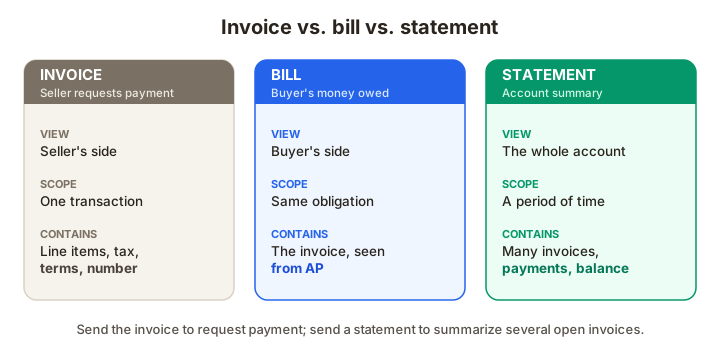
Three documents that get mixed up
People use invoice, bill, and statement interchangeably in casual conversation. In accounting, they are not quite the same.
An invoice is the seller's request for payment. A bill is the buyer's view of money owed. A statement is a summary of account activity over time.
That sounds fussy until a client says, "Can you resend the bill?" and you send a statement when they needed the original invoice — or you send a fresh invoice for a balance that was already invoiced, creating a duplicate in their AP system. The words affect the workflow.
What an invoice does
An invoice is the document that starts the payment clock. It says:
- Who sold the goods or services
- Who owes the money
- What was sold
- How much it costs
- What tax applies
- When payment is due
- How to pay
- Which invoice number identifies the transaction
Invoices belong in accounts receivable. If you send one, you are saying "this amount is now due under these terms." That is why invoice numbers matter and why you should not issue a second invoice for the same work unless you are correcting or replacing the first one deliberately.
Use an invoice when you have delivered work, reached a milestone, shipped goods, or otherwise earned the right to request payment.
What a bill does
A bill is usually the same obligation from the buyer's side. You issue an invoice; your customer receives a bill.
In some industries, "bill" is the normal customer-facing word — utility bill, medical bill, restaurant bill, legal bill — but the function is the same: money is owed.
If you are running a small business, do not worry if a client calls your invoice a bill. Just keep your own records consistent. The file you issue should still have an invoice number, issue date, due date, line items, and total.
What a statement does
A statement is not one transaction. It is a summary of an account.
A monthly statement might show:
| Date | Item | Debit | Credit | Balance |
|---|---|---|---|---|
| Aug 1 | Invoice INV-1042 | $900 | $900 | |
| Aug 8 | Payment | $400 | $500 | |
| Aug 15 | Invoice INV-1047 | $300 | $800 |
The statement tells the customer where the account stands. It does not replace the original invoices. If the customer needs line-item details or tax treatment, they need the invoice behind each row.
Statements are most useful when a customer has:
- Multiple open invoices
- Partial payments
- Credits
- A running balance
- A long-term account relationship
Invoice vs bill vs statement: when to send each one
Use this simple rule:
- Send an invoice when you are requesting payment for specific work, goods, or a milestone.
- Send a receipt when payment has been made.
- Send a statement when you need to summarize a customer's account across several invoices and payments.
If a customer is late on one invoice, resend the invoice with a polite note. If they are late on three invoices, send a statement that shows all three balances plus copies of the invoices.
Common mistakes
Sending a statement as the first payment request. AP needs an invoice number, tax details, and line items. A statement usually does not have enough detail to approve payment.
Creating a new invoice for an old balance. This can duplicate revenue in your books and create two open invoices for the same work. Send a statement or past-due notice instead.
Calling everything a receipt is another common slip. A receipt confirms payment — it should not be used to ask for payment.
Skipping invoice numbers because the client says "bill." Your system still needs a stable identifier.
The clean workflow
For a normal client job:
- Send an estimate or quote before work starts.
- Send an invoice when payment is due.
- Send a receipt after payment clears.
- Send a statement only if the account has multiple invoices, credits, or open balances.
That sequence keeps the documents from stepping on each other — each one has a distinct job and a distinct moment.
A quick example
You design a logo for $1,200.
You send Invoice INV-1021 for $1,200 due in 15 days. The client pays $600. Two weeks later, you send a statement showing INV-1021, the $600 payment, and a remaining $600 balance. When the final $600 arrives, you send a receipt showing the invoice paid in full.
One invoice. One statement. One receipt. No duplicates.
Create the right document
If you need to request payment, start with the invoice. Create an invoice in Issueable, then issue a receipt or statement only when the account activity calls for it.
Frequently asked questions
- Is an invoice the same as a bill?
- They often describe the same request for payment from opposite sides. The seller issues an invoice; the buyer receives it as a bill. A utility company sends you a bill; you send your client an invoice. In your own business records, use invoice for the document you send to request payment, and give it an invoice number either way.
- What is a statement?
- A statement summarizes account activity over a period. It can list several invoices, payments, credits, and the remaining balance, so the customer can see where the account stands at a glance. It is not usually the original request for payment; if the customer needs line-item or tax detail, they need the invoice behind each row.
- Can I send a statement instead of an invoice?
- Usually not. A statement summarizes account activity, while an invoice carries the transaction-level detail and any required tax fields. Follow the buyer's process and applicable invoicing rules; use a statement to summarize open invoices rather than silently replacing them.
- Does a bill need an invoice number?
- If you are the seller, give the document an invoice number even if the customer calls it a bill. The number is how both sides track payment, credits, disputes, and year-end records. Without one, a partial payment or a question six months later has nothing to anchor to.