Getting Paid Internationally: FX, Fees, and Currency
The Issueable Team
Small business operations
The stated fee is only one part of a cross-border payment. Compare the exchange rate, intermediary charges, receiving fees, timing, and invoice currency before choosing a method.
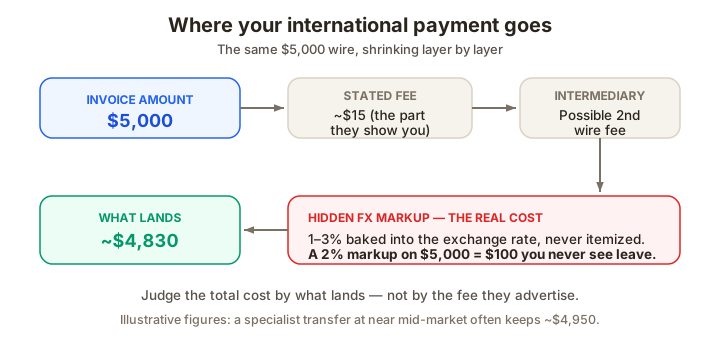
The fee you see isn't the fee you pay
An overseas payment can arrive short even when the stated transfer fee looks small. The provider may earn a spread on the currency conversion, and intermediary or receiving banks may deduct charges before the money lands.
Once you know where the real cost hides, choosing a payment method and an invoice currency gets a lot clearer. Below: the hidden cost, the methods, and what to put on the invoice.
The hidden cost lives in the rate
Currencies trade across markets at changing bid and ask prices. A published mid-market rate is a useful reference, not a rate every customer can transact at. Providers may add a spread to that reference rate instead of listing the entire conversion cost as a separate fee.
For example, a 2% spread on a $5,000 conversion is $100. The percentage is illustrative, not a typical quote. Compare the offered rate with an independent reference and focus on the final amount received rather than the headline fee.
Comparing the methods
Three broad options, with different cost shapes:
International bank wire (SWIFT). A widely supported route that may involve sending, intermediary, and receiving-bank fees. Ask whether charges are sent as OUR, SHA, or BEN and whether the quoted amount is guaranteed to arrive.
General payment platforms. Convenient for many clients, but pricing can combine transaction, cross-border, withdrawal, and conversion charges. Read the fee schedule for the payer's and recipient's countries.
Specialist transfer services. These may quote the fee and recipient amount more transparently, but availability, safeguards, limits, and pricing vary. Compare a live quote rather than assuming the provider category determines the winner.
The right pick depends on the amount and country pair. Compare the final recipient amount after the stated fee, exchange-rate spread, and any sending, intermediary, receiving, or withdrawal charges.
What currency to invoice in
This is a genuine decision, not a default, and it determines who bears the conversion.
- Client currency can reduce payment friction but leaves you exposed when you convert the proceeds.
- Your currency gives you a predictable invoice amount but asks the client to handle conversion and may complicate their payment process.
Whichever you pick, state the currency explicitly: "$1,000 USD," never a bare "$1,000." The dollar sign is shared by the US, Canada, Australia, and others; an unlabeled amount across a border is a dispute waiting to happen. (For the specific US/Canada case, see invoicing in USD vs CAD.)
Protecting a long project from rate swings
On a multi-month engagement invoiced in a foreign currency, the exchange rate can drift between the day you quote and the day you're paid, quietly changing what you actually earn for the same work. Three ways to limit that exposure:
- Invoice in your own currency, so the rate risk sits with the client.
- Bill in shorter milestones, so each conversion happens close to when the work was done and no single payment is exposed for long. (Deposits and milestone billing covers the structure.)
- Agree a rate mechanism up front for very large or long contracts, so neither side is surprised by a swing.
The longer and larger the project, the more this can matter. Even a short project can be exposed during a volatile period, so compare the risk with the effort of adding a more complex term.
How to run a worked comparison
For the same invoice, collect a live quote from each method at roughly the same time. Record the amount sent, currency, stated fee, offered rate, intermediary-fee policy, and exact amount expected to arrive. Divide the shortfall from the independent reference conversion by the invoice amount to compare the all-in percentage cost.
Open a local receiving account
If you regularly invoice in a foreign currency, a local receiving account may let the client make a domestic transfer and let you choose when to convert. Check account eligibility, safeguarding or deposit-insurance status, receiving fees, withdrawal rules, and tax reporting before holding a material balance there.
Check the tax and reporting rules at home
Receiving money from abroad can create income-tax, indirect-tax, information-reporting, and foreign-account obligations. The rules depend on your tax residence, entity, customer, service, account location, and applicable treaties. For US federal reporting, the IRS generally requires amounts on a return to be stated in US dollars and provides guidance on exchange rates; other countries use their own conversion rules. Keep the original currency amount, payment date, fees, and rate used, and confirm the treatment with a qualified adviser.
Invoice across borders cleanly
Issueable lets you set the currency explicitly and add the payment details an international client needs. Create your invoice, label the currency without ambiguity, and choose the payment method by total cost, not by the fee they put in front of you. For the mechanics of online payment generally, see how to get paid online.
Frequently asked questions
- Where does the real cost of an international payment hide?
- The exchange-rate spread can cost more than the stated fee, and intermediary or receiving banks may deduct charges as well. Compare the amount the recipient will receive with the amount sent, using a current independent market rate as a reference.
- What's the cheapest way to receive money from abroad?
- It depends on the currencies, countries, amount, speed, and recipient. Ask each provider for a quote showing the amount that will arrive, then compare that result with bank wires and payment platforms. The cheapest method for one corridor may not be cheapest for another.
- What currency should I invoice in?
- Choose the currency after considering buyer preference, your costs, exchange-rate exposure, payment rails, and bargaining position. Invoicing in the client's currency may simplify their approval process; invoicing in yours makes your stated receivable easier to predict. Either way, identify the currency explicitly, such as '$1,000 USD' rather than '$1,000.'
- Who absorbs the conversion cost?
- Decide and state it up front. If you invoice in your currency, the client bears the conversion when they pay; if you invoice in theirs, you bear it when the money lands. For ongoing international clients, many freelancers invoice in their own currency and treat any residual FX cost as the price of a simpler, predictable number, but the right answer depends on who has more leverage and which currency is more stable.
- How do exchange-rate swings affect a long project?
- On a multi-month project invoiced in a foreign currency, the rate can move meaningfully between quote and payment, quietly changing what you actually earn. For long or large engagements, either invoice in your own currency, bill in shorter milestones so each conversion happens close to when it's earned, or agree a rate mechanism up front. Staging payments (see deposits and milestone billing) also limits how much is exposed to any single swing.