EU VAT and the Reverse Charge: Invoicing Cross-Border B2B
The Issueable Team
Small business operations
When you invoice a VAT-registered business in another EU country, you often charge no VAT at all, the buyer accounts for it instead. That's the reverse charge. Here's when it applies, the VAT-number check you must run first, and exactly what the invoice has to say.
The invoice with no VAT on it
The first time you invoice a business in another EU country, the correct invoice can look wrong: you charge no VAT at all. You haven't forgotten it, and you're not doing the client a favor. This is the reverse charge — the EU's way of handling tax on cross-border business-to-business sales without forcing you to register for VAT in every country you sell into. Instead of you collecting the tax, the buyer accounts for it in their own return.
The logic clicks once you see it, and after that it's routine. Below: when the reverse charge applies, the one check you must run before you rely on it, the exact wording your invoice needs, and how all of this differs from the OSS scheme.
When the reverse charge applies
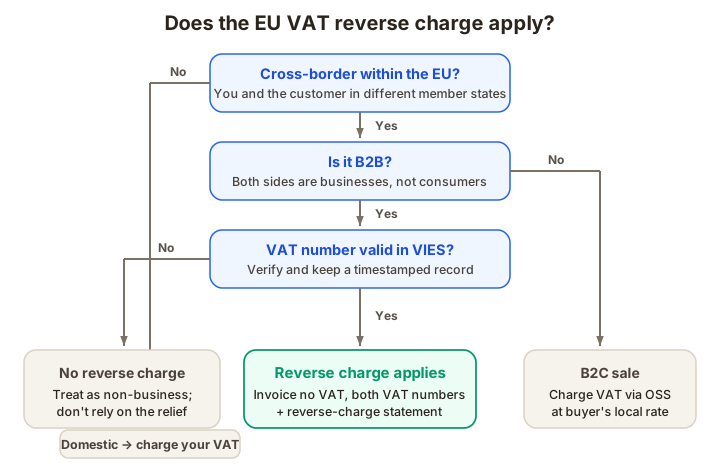
Three conditions, broadly, have to line up:
- The sale is cross-border within the EU; you're in one member state, the customer in another.
- It's a qualifying B2B supply. The cross-border business-to-business rule described here is not the consumer-sales treatment.
- The supply qualifies under the place-of-supply rules. For most cross-border B2B services between VAT-registered businesses, reverse charge is the default treatment; certain goods and special categories follow their own rules.
When those hold, you issue an invoice with no VAT, and the customer self-accounts for it. You've moved the VAT obligation to them, legitimately, and avoided registering abroad.
Step one, before anything: validate the VAT number
The whole mechanism rests on the customer genuinely being a VAT-registered business, so you have to prove they are. Before you issue the invoice, run their VAT number through the European Commission's VIES validation tool and keep a timestamped record of the result.
This is not a formality to skip. If you apply the reverse charge against a VAT number that turns out to be invalid (or that you never checked), the legal protection of the mechanism may not apply, and the tax authority can come to you for the VAT you didn't charge. The check takes under a minute, and the timestamped record is your defense if anyone asks later. Make it a hard step in your process.
What the invoice has to say
A compliant reverse-charge invoice differs from a domestic one in three specific ways:
- Both VAT numbers (yours and the customer's) appear on the invoice.
- No VAT is charged. The line items and total carry no tax.
- An explicit reverse-charge statement is included. Standard wording: "Reverse charge: VAT to be accounted for by the recipient under Article 196 of Council Directive 2006/112/EC." The exact article can vary with the type of supply, but the statement must make clear that the recipient accounts for the VAT.
On top of the invoice itself, EU-established suppliers generally have to report these sales on a recapitulative statement (often called an EC Sales List), a periodic filing that lists the cross-border B2B supplies you made and to whom. The invoice and the statement work together; doing one without the other is incomplete.
Reverse charge vs. OSS: don't mix them up
These two schemes get confused because both involve cross-border EU VAT, but they serve opposite customers.
- Reverse charge applies to B2B sales — between VAT-registered businesses. The buyer accounts for the VAT.
- OSS (One-Stop Shop) applies to B2C sales to consumers. It lets you report and pay VAT owed across all member states through a single registration in your home country, rather than registering in each one.
The question that routes you is simply who is the customer? A VAT-registered business in another member state: reverse charge, no VAT on the invoice. A consumer in another member state: OSS, with VAT charged at the customer's local rate. Getting this wrong means either charging VAT you shouldn't or failing to charge VAT you must.
What a reverse-charge invoice looks like
Concretely, a German consultancy billing a French client for €4,000 of advisory work issues something like this:
Strategy advisory: Q4 engagement                 €4,000.00
                                       Subtotal    €4,000.00
VAT                                                     €0.00
                                          Total    €4,000.00

Supplier VAT: DE123456789
Customer VAT: FR12345678901 (validated via VIES, 2026-10-22)
Reverse charge: VAT to be accounted for by the recipient
under Article 196 of Council Directive 2006/112/EC.
No VAT line carries a value, both VAT numbers are present, and the statement spells out who accounts for the tax. The French client then records both the input and output VAT in their own return, netting to zero for them while keeping the paper trail intact.
Goods follow different rules from services
Most of what's above describes cross-border B2B services, where reverse charge is the workhorse. Goods that physically move between member states follow a parallel-but-distinct regime: an intra-Community supply, which can be zero-rated when the customer's VAT number is valid, the goods genuinely leave your country, and you hold evidence of the movement. The customer then accounts for acquisition VAT on their side.
The practical upshot is the same (you often invoice without charging VAT and the buyer self-accounts) but the conditions and the evidence you must keep differ. If you ship physical goods rather than deliver services, confirm the intra-Community supply rules specifically rather than assuming the services treatment carries over.
Common mistakes
The reverse charge is mechanical, but a few errors recur:
- Applying it to a consumer. Reverse charge is B2B only. A "business" customer with no valid VAT number is treated like a consumer for this purpose; you can't reverse-charge them.
- Skipping or not retaining the VIES check. An unverified VAT number can void the mechanism's protection. Validate and keep the timestamped result.
- Omitting the statement. No reverse-charge wording on the invoice means non-compliance, even if the VAT treatment was otherwise correct.
- Forgetting the recapitulative statement. The invoice is only half the obligation; EU-established suppliers must also file the EC Sales List for these supplies.
- Charging your domestic VAT "to be safe." This creates its own problems: the customer pays tax they can't easily recover, and your own return is wrong.
A note on where this is heading
The EU's "VAT in the Digital Age" (ViDA) reforms are rolling out across 2026–2030, moving toward standardized e-invoicing and near-real-time digital reporting for cross-border trade. None of it changes the fundamentals above in the near term, but if you do regular intra-EU B2B work, it's worth knowing the direction: structured, electronic invoices are becoming the expectation rather than the exception.
This article is orientation, not tax advice. Cross-border VAT has genuine complexity at the edges (mixed supplies, non-EU sellers, digital services), so confirm your specific situation with a VAT adviser. For the UK's post-Brexit treatment, see VAT on UK invoices.
Invoice cross-border, correctly
Issueable lets you issue an invoice with both VAT numbers, zero VAT, and a custom note for the reverse-charge statement. Create your invoice and keep your VIES check on file alongside it.
Frequently asked questions
- What is the VAT reverse charge?
- It's a mechanism that shifts responsibility for VAT from the seller to the buyer on qualifying cross-border B2B sales within the EU. Instead of you charging VAT, collecting it, and remitting it, you invoice with no VAT and the customer accounts for both the input and output VAT in their own return. It removes the need for you to register for VAT in every country you sell to.
- When does the reverse charge apply?
- For the cross-border rule covered here, it commonly applies when you supply qualifying services to a VAT-registered business in another EU member state. Consumer sales follow different place-of-supply and collection rules. Goods and special service categories can also differ, so confirm the treatment for what you sell.
- Do I have to check the customer's VAT number?
- Yes: verify it in the EU's VIES system before you issue the invoice, and keep a timestamped record of the result. The reverse charge depends on the customer being a valid VAT-registered business; if you apply it against an invalid or unverified VAT number, the legal protection of the mechanism may not hold and you could be liable for the VAT yourself. The check takes under a minute and is your evidence if questioned.
- What must the invoice say?
- Show both your VAT number and the customer's, charge no VAT, and include an explicit reverse-charge statement, wording such as 'Reverse charge: VAT to be accounted for by the recipient under Article 196 of Council Directive 2006/112/EC.' EU-established suppliers must also report the sale on a recapitulative statement (EC Sales List). Without the statement and both VAT numbers, the invoice isn't compliant.
- How is OSS different from the reverse charge?
- They cover different customers. The reverse charge handles B2B sales between VAT-registered businesses. The One-Stop Shop (OSS) handles B2C cross-border sales; it lets you report and pay the VAT due in other member states through a single registration in your own, instead of registering in each country. If you sell to consumers across the EU, you're in OSS territory; if you sell to businesses, you're in reverse-charge territory.
- I'm outside the EU, does this affect me?
- It can. If you're a non-EU business selling services to EU businesses, the customer typically still accounts for VAT under the reverse charge, so you invoice without EU VAT. Selling digital services to EU consumers is different and may require non-Union OSS registration. The rules are genuinely intricate at the edges, so treat this as orientation and confirm your specific case with a VAT adviser.