Estimate vs Quote: Differences and When to Use Each
The Issueable Team
Small business operations
An estimate usually gives a working price range, while a quote states firmer terms. Learn how wording and acceptance affect each document.
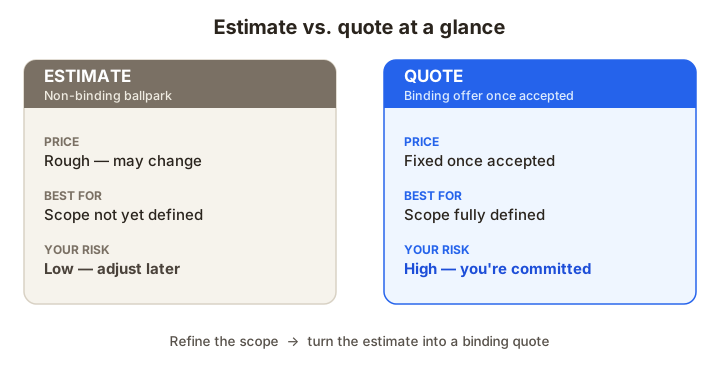
The practical difference: pricing certainty
Businesses often use "estimate" for a provisional price and "quote" for firmer pricing, but the label alone does not determine legal effect.
An estimate usually communicates a working figure based on stated assumptions: "Based on the visible scope, expected cost is about $5,000." It should identify what could change the price, such as hidden conditions or added scope.
A quote usually states a firmer price for a defined scope and period. Whether it becomes a binding contract depends on its terms, acceptance, the parties' conduct, and governing law. Use change-order language for work outside the quoted scope.
Most small-business confusion comes from using "quote" when they mean "estimate," or vice versa. Customers end up expecting fixed prices when you meant to give a ballpark, or you find yourself locked into a fixed price when you wanted flexibility.
When to use an estimate
Use an estimate when:
- The scope isn't fully defined. You're saying, "I'll need to look deeper before I can give you an exact price."
- Surprises are likely. Construction, renovation, or repair work often uncovers hidden issues. An estimate gives you (and the customer) flexibility.
- Time is uncertain. Design revisions, client feedback loops, or scope creep could extend the timeline. Estimate the hours, but flag that extra revisions may cost more.
- The customer is price-shopping. An estimate is a low-friction way to give a ballpark so they can compare. You can adjust later once the scope becomes clearer.
How to make an estimate's pricing basis clear:
"Based on the information provided, we estimate this project will cost $5,000–$7,000 and take 3–4 weeks. The final cost may vary based on scope changes, revisions, or unforeseen issues. We'll confirm a fixed quote once we've reviewed all requirements in detail."
The risk of an estimate:
If you estimate "around $5,000" and the customer accepts without further discussion, they may assume that's the maximum price. State the assumptions and next step plainly, for example: "Final cost is subject to a detailed scope review." A disclaimer helps communicate intent, but it does not by itself decide whether an agreement was formed.
When to use a quote
Use a quote when:
- The scope is fully defined. You've seen the requirements, asked all your questions, and you're ready to commit to a price.
- You want to protect yourself. A quote with clear line items, deliverables, and exclusions ("Does not include revisions beyond two rounds") protects both you and the customer.
- The customer needs firm commercial terms. Some enterprise and government buyers request a formal quote before issuing a purchase order.
- You want to close the deal. A quote with a clear price and timeline signals confidence and readiness.
How to make acceptance terms clear:
"Quote for [Project Name]. We will provide the following deliverables for $5,000, due by [date]. This quote is valid until [expiration date]. Scope includes [list specific deliverables]; excludes [list exclusions, e.g., 'client revisions beyond two rounds,' 'rush fees,' 'travel costs']. Upon acceptance, you agree to these terms."
The protection a quote gives you:
A signed or emailed acceptance creates useful evidence of the agreed scope and price. Whether the quote alone forms the complete contract still depends on its terms and governing law, so include or reference the other terms that matter.
Comparison: estimate vs. quote
| Factor | Estimate | Quote |
|---|---|---|
| Typical intent | Provisional working figure | Firmer price for a defined scope |
| Price certainty | Usually provisional | Usually firmer for the stated scope |
| Best for | Uncertain scope, price-shopping | Defined scope, deal closure |
| Timeline | Flexible | Firm (or states exclusions) |
| Risk to you | Depends on assumptions and wording | Depends on scope, exclusions, and acceptance |
| Customer expectation | "This may change for stated reasons" | "This price covers the stated scope" |
| Sample language | "We estimate ~$5,000" | "We quote $5,000" |
How to turn a quote into an invoice
Once a customer accepts a quote, converting to an invoice is straightforward:
- Confirm acceptance. Email the customer: "Thanks for approving the quote. I'm issuing the invoice now."
- Create a separate invoice. Keep the accepted quote, then generate an invoice with its own invoice number and issue date.
- Add payment terms. Add the agreed due date and payment instructions.
- Carry over the agreed items. Transfer the accepted deliverables and prices, including any approved change orders or deposit treatment.
- Send and track. Send the invoice and wait for payment.
Issueable carries the quote details into a new invoice so you can add the invoice-specific number, dates, and payment terms without re-keying the scope.
Protecting yourself with clear terms
For either document, include these six things:
- What's included: "Scope includes 3 rounds of revision" or "Service includes up to 10 hours of design work."
- What's excluded: "Does not include rush fees, client travel, or changes to core requirements." This is what keeps scope creep from becoming an argument.
- Timeline: "Delivery by June 15, 2026" or "Estimated 2–3 weeks from approval."
- Payment terms: "50% deposit on acceptance, 50% on delivery" or "Net 30 from invoice."
- Revision or change-order policy: "Additional revisions beyond the scope cost $150/hour" or "Scope changes require a written change order."
- Expiration date: "This quote expires June 15, 2026. After that date, pricing may change." Estimates should include this too.
Common estimate mistakes
1. Using "estimate" and "quote" interchangeably. If you send a document labeled "Estimate" but word it like a binding offer ("We will deliver X for exactly $5,000"), the customer reads it as a quote. Be explicit about whether you're ballparking or committing.
2. Sending an estimate without mentioning scope limits. If you estimate $5,000 for "website design" but don't specify how many pages, revisions, or deliverables, the customer may expect far more than you intended. Define scope boundaries even in estimates.
3. Not mentioning an expiration date. If your estimate for construction materials is valid for 30 days but the customer comes back 90 days later, prices may have shifted. State the date or condition after which pricing must be refreshed.
4. Assuming the document label answers the contract question. It does not. Get written confirmation of scope, price basis, and acceptance before starting work.
Common quote mistakes
1. Forgetting to mention what's excluded. "We quote $5,000 for logo design" — does that include brand guidelines? Website favicon? Social media templates? Spell out what's not included so the customer doesn't assume it's free.
2. Changing price without following the agreed process. If the customer accepted fixed pricing for a defined scope, use the contract's amendment or change-order process. A unilateral increase can create a dispute and may not be enforceable.
3. Quoting without documenting known requirements. You may not uncover every dependency before work begins, but you can list the requirements, assumptions, and exclusions the price relies on.
4. Not specifying a revision policy. "Logo design: $2,000": does that include unlimited revisions, or just two rounds? State what is included and how additional rounds will be approved and priced.
The estimate-to-quote workflow
Many service businesses use this workflow:
- Initial conversation. Understand the customer's needs and constraints.
- Send an estimate. "We estimate $5,000–$7,000 based on what we know, pending a detailed requirements review."
- Customer reviews. They ask questions, clarify scope, provide additional details.
- You refine the scope. You now have full clarity on deliverables, timeline, and complexity.
- Send a quote. "We quote $5,500 for [specific, detailed deliverables]."
- Customer accepts. Email or signed acceptance ("I approve the quote dated June 1, 2026").
- Convert to invoice. Add the agreed payment terms and send. Keep the accepted quote, contract, change orders, and invoice together as the transaction record.
- Get paid. Per your agreed terms (Net 30, Due on Receipt, etc.).
By the time you quote, everyone has agreed on scope, timeline, and deliverables, which is what keeps disputes from happening later.
When an estimate becomes a problem
Here's a scenario: You send an estimate for "website redesign: $6,000–$8,000." The customer verbally says, "OK, go ahead." You start work. Two weeks in, you realize the scope you're delivering is worth closer to $10,000 (more complex than you estimated). The customer disputes any higher price because they thought they hired you at $6,000–$8,000.
The fix: Before starting work on an estimate, send a follow-up email: "Before we begin, I want to confirm: the $6,000–$8,000 estimate assumes [specific scope]. Once we finalize requirements, I'll send a fixed quote. Does that work?" Get written confirmation.
Ready to send estimates and quotes?
Issueable's quote generator calculates totals, includes a validity date and acceptance block, and can carry the quote details into a new invoice. Keep the customer's actual approval with your project records.
Frequently asked questions
- Can a customer hold me to an estimate price?
- Potentially. A document's title is not decisive; its wording, completeness, acceptance, later communications, performance, and governing law all matter. State whether the price is fixed or provisional, what assumptions can change it, and what action constitutes acceptance.
- Is a verbal estimate legally binding?
- An oral agreement can be enforceable in some circumstances, although writing and signature requirements apply to certain transactions and jurisdictions. Confirm scope, price assumptions, and acceptance in writing before work begins; do not rely on a universal dollar cutoff.
- What if the scope changes after I've sent a quote?
- Use the amendment or change-order process in your agreement. Describe the added scope, price, and schedule impact, then obtain the required approval before doing the extra work. Written approval is the clearest record, but the exact form depends on the contract and governing law.
- Can I convert a quote into an invoice automatically?
- Yes. Once the customer accepts the quote and payment is due under your agreement, create a new invoice from its details. Give the invoice its own number, issue date, due date, and payment terms while retaining the accepted quote. Issueable carries the line items and customer details into the new document.
- Should I charge a fee for providing an estimate?
- Charge when producing the estimate requires meaningful diagnosis, design, travel, or technical work. Disclose the fee before doing that work and say whether it will be credited toward the project. The right amount depends on the work involved, not the estimated project price.
- How long should an estimate be valid?
- Use an exact expiration date based on supplier-price volatility, scheduling capacity, and the customer's approval cycle. If pricing may change sooner because of a supplier quote or another dependency, state that condition explicitly.