Change Orders: Adjusting a Quoted Price
The Issueable Team
Small business operations
Scope changes, surprise fees, and "can you also just add this one thing", the practical mechanics of issuing a change order that protects the relationship and the project budget.
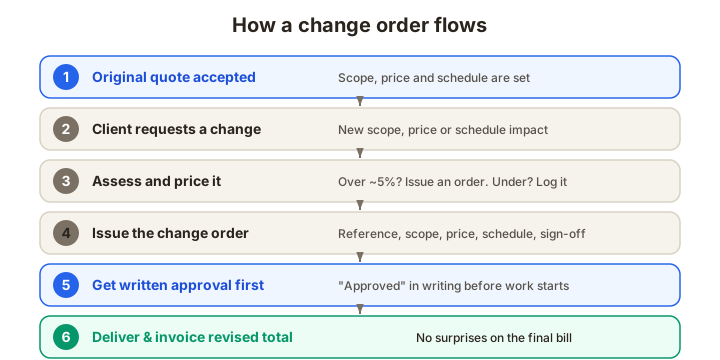
Why every project needs a change-order process
Most projects experience scope changes. The buyer's needs evolve, your assumptions turn out wrong, an interim deliverable surfaces a new requirement. None of that is a problem on its own — it becomes one when you do the extra work, bill for it on the final invoice, and the client responds with "we never agreed to that."
A change order closes the loop before the work is done. The client sees the scope change, the price, the schedule impact, and signs off. The work proceeds; the invoice contains no surprises; the relationship survives.
Below: when to issue a change order, what it has to contain, how to phrase the conversation, and how to avoid the most common mistakes — chief among them doing the work first and asking for approval after.
When a change order is required
Issue a change order whenever the original quote or contract no longer accurately describes:
- Scope: what you're delivering. New deliverables added, existing ones removed, specifications materially changed.
- Price: the agreed amount. Any time the price changes, even a small credit or discount.
- Schedule: the timeline. New milestones, delayed completion dates, accelerated delivery.
- Materials or specifications: in construction or manufacturing, any change to the agreed materials, parts, or finishes.
The threshold for a material change depends on the agreement and the work. If a request changes price, schedule, deliverables, or responsibility, documenting it is safer than relying on a percentage rule.
In FAR-governed work and projects using AIA forms, follow the contract's notice and authorization process exactly; informal approval may not preserve the right to payment or extra time.
The five essentials of a change order
Every change order (formal or simple) should contain:
- Reference to the original document. Contract number, original quote, or PO — without this anchor, the change order floats and the project history becomes harder to reconstruct.
- Clear scope description. What's being added, removed, or modified. Be specific: "Add a third revision round for homepage copy, deliverable by July 15" beats "additional revisions."
- Price impact. The dollar amount of the change. A positive number for additions, a negative for credits, "$0" for scope swaps with no cost change.
- Schedule impact. The new milestones or completion date. If the change has no schedule effect, say so.
- Acceptance. Obtain the signature, electronic approval, or other authorization required by the original agreement. For an informal project that permits email approval, ask for an explicit "Approved, please proceed."
Two additional fields are valuable but not always required:
- Reason for the change. Useful in any future dispute or project retrospective. "Buyer-requested: scope expanded to add Spanish-language version" is concrete and hard to argue with later.
- Cumulative running total. If you've issued multiple change orders, show the original contract sum, all prior changes, this change, and the new contract sum. AIA G701 builds this in by default.
A widely recognized construction form: AIA Document G701
The American Institute of Architects' G701 form is the most-recognized change-order document in US construction. It's used in projects ranging from residential remodels to commercial builds, and most subcontractors and architects have seen one. The form's structure:
- Header: project name, owner, architect, contractor, contract date, change order number.
- Description of the change in the contract.
- Original contract sum.
- Net change by previously authorized change orders.
- Contract sum prior to this change order.
- Contract sum will be increased / decreased / unchanged by this change order in the amount of $X.
- The new contract sum, including this change order, will be $Y.
- The contract time will be increased / decreased / unchanged by N days.
- The date of substantial completion as of the date of this change order is therefore Z.
- Signature blocks for the architect, contractor, and owner.
If you do US construction work, it is useful to recognize G701 and related forms, especially when a project already uses AIA contract documents.
How to write a change order for non-construction work
Most freelancers and small businesses don't need a G701. A short email or one-page document with the five essentials is enough. A working template:
Subject: Change Order #2 (Project Falcon) Add Spanish localization
Reference: Master agreement dated April 5, 2026; Quote Q-2026-088.
Scope change: Add Spanish-language version of the marketing site (12 pages currently in English). Translation by our partner translator; QA pass and integration into existing CMS handled by us.
Price impact: +$3,400 USD. New project total: $19,800 USD (originally $16,400).
Schedule impact: Final delivery moved from August 22 to September 5 (2-week extension).
Other terms: All other terms of the original agreement remain in effect.
Please reply "approved" to authorize, or let me know if you'd like to adjust scope. Once approved, this change order becomes part of our agreement.
That covers the five essentials in fewer than 200 words. Use this lighter approach only when the original agreement allows approval by email.
The conversation: how to raise a change order without sounding like a lawyer
The most common mistake isn't the document; it's the conversation. Two phrases that work:
- "Happy to do that, let me put together a quick change order so we both have it in writing." Frames the process as a courtesy, not a legal weapon. Most clients respond well.
- "That's outside the original scope, so let me price it. I'll send something today." Acknowledges the request, sets expectations on speed, and signals that you'll be specific.
Two phrases to avoid:
- "That's not in the contract." Legally accurate but corrosive. "That's outside what we quoted" gets you back on collaborative ground faster.
- "I'll just throw that in." Even when you intend to absorb a small change, say so explicitly: "Happy to do that on the house this time" — both parties acknowledge the gift, and the scope of "the house" stays bounded.
Tactics that stop scope creep
The habits that prevent most change-order disputes:
Name the scope explicitly in the original quote. Don't just describe what's in scope, describe what's out. A quote that says "Includes: homepage, 5 interior pages, 1 round of revisions per page. Not included: blog setup, e-commerce, third-language localization, content migration from existing site" gives both sides a clean reference point.
Document assumptions. "This quote assumes the existing brand guide is finalized; substantial brand changes mid-project will require a change order." Assumptions written down become a shared understanding; assumptions left unwritten become disputes.
Price uncertainty deliberately. If the scope contains known unknowns, include a stated allowance or contingency that fits the actual risk. Keep customer-requested additions separate so contingency does not become an informal substitute for approval.
Time-and-materials vs. fixed-price: how change orders differ
The change-order process depends on the contract structure.
Fixed-price contracts commonly require the agreed change process for work outside the defined scope. Check the contract before relying on an informal approval.
Time-and-materials (T&M) contracts bill by the hour or unit of material, but they may still include a budget cap, notice requirement, or defined scope. Document material changes before the expected total moves beyond what the buyer approved.
Hybrid contracts carry a fixed-price baseline plus T&M for excess. Changes within the fixed scope follow the fixed-price rules; T&M overflow is invoiced on actuals. Treat any material drift as worth a status email even if it doesn't legally require a change order.
Common change-order mistakes to avoid
- Doing the work first. By the time the work is done, the buyer's incentive to approve a change order is gone. Obtain the required authorization before starting unless an emergency or the contract's directive process applies.
- Verbal-only agreements. "We talked about it on the phone" is weak evidence in a dispute. Confirm the discussion in writing and follow the contract's approval process; an email summary alone may not authorize the change.
- Vague scope language. "Additional revisions" without a count or "extra work" without a specification creates a fresh dispute. Be concrete.
- Forgetting the schedule impact. A change order with a price but no new completion date assumes the original schedule still holds. If it doesn't, say so.
- Skipping change orders on small changes. Small changes accumulate. Three small absorbed changes are usually fine; eleven are a budget problem and a relationship problem. Track even the small ones.
- Changing the original document. Preserve the accepted original and record the amendment separately. The legal effect of the combined documents depends on valid approval and the governing agreement.
A 6-line change-order checklist
- Reference to the original contract, quote, or PO
- Specific scope description (in / out / modified)
- Price impact (with new contract total)
- Schedule impact (with new completion date if changed)
- Buyer's written approval before work begins
- Filed with the original project records, sequentially numbered
Ready to handle scope changes cleanly?
Use Issueable's quote generator to lay out the revised scope, price, schedule, and original agreement reference. Save the accepted original separately, label the new document clearly, and obtain the approval your contract requires.
Frequently asked questions
- What is a change order?
- A change order is a documented amendment to an existing agreement that adjusts scope, schedule, or price. The original contract controls the approval formalities: signatures may be required, while some agreements permit explicit electronic approval. AIA Document G701 is a widely recognized construction form, but the same change-management principle helps in design, software, consulting, and manufacturing.
- Do I have to use a formal change order, or can a verbal agreement work?
- A verbal modification may be enforceable in some circumstances, but the contract itself may require written changes, and rules differ for services, construction, and sales of goods. Confirm the change in writing and obtain the form of approval required by the original agreement. An email may be enough for informal work, but it is not a substitute for a required signature or formal change-order process.
- What does a change order need to include?
- Five essentials: (1) reference to the original contract, quote, or PO; (2) a clear description of what changes; (3) the price impact; (4) the schedule impact; and (5) the approval required by the original agreement. Email can document approval when the contract permits it, but it is not automatically equivalent to a required signature. AIA G701 also tracks the prior contract sum, change amount, and new contract sum.
- Should I charge for small changes or absorb them?
- Document any change that affects price, timing, deliverables, or responsibilities. You may choose to absorb a true clarification or a small cost, but record that decision so several small requests do not quietly become a material scope increase.
- What's the difference between a change order and a change directive?
- A change order is a fully agreed amendment: both parties have signed off on the scope, price, and schedule. A change directive (used in larger construction contracts and government work) is a unilateral instruction from the client to proceed with a change before the price has been negotiated. The contractor must comply, and the cost is determined later, often through a defined formula or arbitration. For most small business work, you only deal with change orders; change directives are a feature of formal contracting environments.
- How do I avoid scope creep without becoming the difficult vendor?
- Three habits help: define what is in and out of scope, assess out-of-scope requests promptly, and keep a written change log. If the project carries genuine uncertainty, price an appropriate contingency based on that risk and explain how it will be used.