W-9 and 1099-NEC for Contractors: Small Business Guide
The Issueable Team
Small business operations
If you pay independent contractors, January has a deadline with your name on it. Get the W-9 at the start of the relationship (not in a panic in January) and the 1099-NEC almost files itself. Here's the workflow, the deadline, and the threshold change that takes effect for 2026 payments.
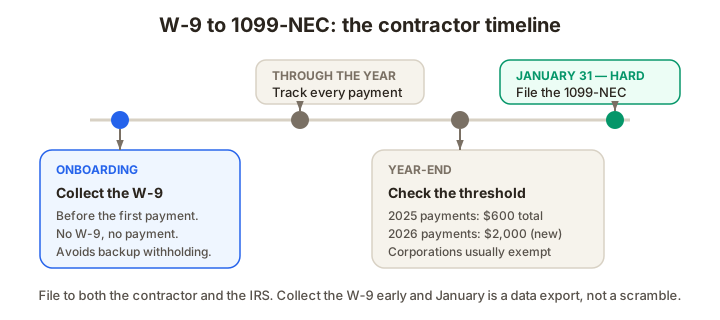
The January problem starts in March
Every year, businesses that pay contractors hit the same wall on January 31: they owe a 1099-NEC to each qualifying contractor and to the IRS, and they're missing half the information they need to produce them. The contractor who did great work in March never sent a W-9, has since changed their business name, and isn't answering email.
The fix isn't a better January. It's collecting the W-9 back in March — at the start of the relationship, before the first payment — so that when the deadline comes, filing is a clerical task instead of an investigation. Below: the whole workflow, the deadline, the penalties, and the threshold change that takes effect for payments made in 2026.
Step one: get the W-9 before you pay
Form W-9 is how a contractor gives you the details you'll need to report what you paid them: their legal name, their business structure, and their Taxpayer Identification Number (TIN). You collect it; you don't send it anywhere. It sits in your files until January.
The discipline that makes everything else easier is timing: make the W-9 part of onboarding, not year-end. Set a written policy for when it must be returned, transmit it through a secure channel, and restrict access because it contains a taxpayer ID. A missing or incorrect TIN can also trigger backup-withholding obligations.
Who gets a 1099-NEC, and the threshold that's changing
You generally issue a 1099-NEC when all of these are true: you paid for services (not goods), in the course of your business (not personal payments), to an unincorporated US person or business (most corporations are exempt), and the yearly total meets the reporting threshold.
That threshold is the detail to get right for 2026, because it's mid-change:
- For 2025 payments (the ones you report in early 2026) the threshold is the long-standing $600.
- For payments made starting in 2026, the 2025 OBBBA legislation raises the threshold to $2,000 (and indexes it for inflation afterward).
Forms filed in early 2026 for 2025 payments used the $600 threshold. Payments made during 2026 use the new $2,000 threshold for forms due in early 2027. If a "$600" rule is built into your process, update it without changing the treatment of prior-year payments.
The deadline: January 31, no extension
Form 1099-NEC is due January 31 (to the contractor and to the IRS) for the prior year. Unlike some other information returns, the NEC form gets no automatic extension, so treat January 31 as immovable. (An extension is only possible in narrow circumstances via a separate form.)
If you collected W-9s up front, hitting the date is straightforward: total each contractor's payments for the year, confirm they're over the threshold, and file. The pain only exists when the data doesn't.
Backup withholding: the cost of a missing TIN
If a contractor won't provide a valid TIN (or the IRS tells you the one on file is wrong) you may be required to withhold a flat 24% of their payments and send it to the IRS. That's backup withholding — a compliance chore for you and a smaller check for them. A complete, valid W-9 collected before the first payment keeps you out of it.
Penalties scale with delay
Late or missing 1099-NECs carry tiered penalties that grow the longer the form is outstanding: modest if you correct within 30 days, larger by August 1, larger again after that, and steepest for intentional disregard. They're charged per form, so a dozen missed 1099s multiply quickly. The exact dollar figures adjust over time, but the shape is consistent: on time costs nothing, late compounds.
NEC or MISC? Putting payments on the right form
The 1099-NEC is specifically for nonemployee compensation, what you pay a contractor for services. But not every business payment goes there, and the classic mistake is forcing everything onto the NEC. A few common splits:
- Services to a contractor → 1099-NEC.
- Rent you pay (office, equipment) → 1099-MISC.
- Attorney payments → here it gets counterintuitive: fees for legal services generally go on the 1099-NEC, while gross proceeds paid to an attorney (e.g., in a settlement) go on the 1099-MISC. Law-firm payments are also a notable exception to the corporation rule below.
If you only pay contractors for work, the NEC covers you. The moment you're also paying rent or legal proceeds, check which form each payment belongs on.
The corporation exception, and its exceptions
You generally don't issue a 1099 to a corporation. This is exactly why the W-9 matters: it tells you the payee's tax classification, so you know whether they're a corporation (usually exempt) or a sole proprietor, partnership, or most LLCs (usually reportable). Guessing leads to both over- and under-reporting.
The exception has its own exception: most importantly, payments to incorporated law firms are still reportable. Let the W-9's classification box drive the decision rather than assuming from the business name.
You probably have to file electronically
The IRS threshold for mandatory electronic filing of information returns is 10 returns, counted in aggregate across almost all form types, not 10 of each. (It dropped from the old 250-per-type rule for returns required to be filed from January 1, 2024 onward.) Practically, if you're filing ten or more 1099s, W-2s, and similar forms combined, paper is no longer an option.
File through the IRS's electronic systems. The IRS says IRIS will be the only intake system for information returns previously accepted through FIRE beginning with filing season 2027. Many accounting and payroll tools can also transmit the forms.
A quick worked example
You paid three people in 2025: a freelance writer ($4,000), your landlord ($12,000 in office rent), and an incorporated software vendor ($9,000). For the filing you do in early 2026:
- Writer → 1099-NEC for $4,000 (over the $600 threshold for 2025 payments).
- Landlord → 1099-MISC for the rent, not an NEC.
- Software corporation → no 1099 (corporation, and not a law firm).
Three payees, three different answers — and the W-9 you collected from each is what told you which was which.
Keep the records
Hold each W-9 and a copy of every 1099-NEC you file for your standard record-retention period (see how long to keep invoices and receipts). The W-9 is your evidence that you collected a valid TIN; the filed 1099 is your evidence that you reported correctly. Together they document every contractor you paid.
This is a guide, not tax advice: the rules around exemptions, electronic-filing requirements, and state-level 1099 obligations have wrinkles, so confirm your situation with the IRS instructions or your accountant. If you're on the receiving end (a contractor being asked for a W-9) see how to invoice an LLC for how your structure affects the paperwork.
Frequently asked questions
- When do I need to issue a 1099-NEC?
- Generally when you pay an unincorporated US contractor for services in the course of your business and the total for the year meets the reporting threshold. For 2025 payments (the ones you report in early 2026), that threshold is $600. Under the 2025 OBBBA legislation, the threshold rises to $2,000 for payments made starting in 2026 (and is inflation-adjusted after that). Payments to most corporations are generally exempt, and personal (non-business) payments don't count.
- What's the deadline?
- Form 1099-NEC is due January 31 (to both the recipient and the IRS) for the prior tax year. There's no automatic extension for the NEC form (unlike some other 1099s), so January 31 is a hard date. Missing it triggers tiered penalties that climb the longer you wait.
- Why collect a W-9 up front instead of in January?
- Collecting tax details after the work is done is harder than making the W-9 part of onboarding. The form gives you the legal name, tax classification, and taxpayer ID needed for information reporting. Store it securely and set a clear policy for when it must be returned.
- What's backup withholding?
- If a contractor won't give you a valid TIN on a W-9 (or the IRS notifies you the one they gave is wrong), you may be required to withhold a flat 24% of their payments (backup withholding) and remit it to the IRS. It's another reason to get the W-9 before the first payment: a complete W-9 with a valid TIN generally means no backup withholding.
- What are the penalties for filing late or not at all?
- They're tiered by how late you are: roughly $60 per form if you fix it within 30 days, more if filed by August 1, and higher still after that or if you never file, with the steepest penalty reserved for intentional disregard. The amounts are per form and adjust over time, so check the current figures, but the shape is clear: file on time and the cost is zero; drift and it compounds fast.