Should Freelancers Form an LLC? Honest Trade-offs
The Issueable Team
Small business operations
An LLC offers liability protection and some tax flexibility, but adds cost and complexity. Here's when it makes sense for freelancers and when it's overkill.
Three reasons freelancers form LLCs
If you're considering an LLC, almost certainly one of these is the actual driver:
- Liability separation, which may protect members from some company obligations but has important state-law and conduct-based exceptions.
- Tax savings via S-corp election: once profits are high enough to support the extra admin, S-corp election can reduce self-employment tax meaningfully.
- Professional credibility — invoicing as "Acme Consulting LLC" reads differently than as "John Smith," and some larger clients or government contracts won't engage with sole proprietors.
The first two are real. The third is mostly cosmetic; clients who actually screen on entity type are a small subset.
If none of these apply to you yet, the LLC might be premature. The annual cost of maintaining one can outweigh the benefit if you're not getting concrete value back.
Liability protection: when it actually matters
The "liability protection" benefit of an LLC sounds compelling but its actual value depends on your specific work.
High-value cases:
- Trade work with injury risk. Electricians, plumbers, HVAC, and contractors face losses that make entity structure and liability insurance worth reviewing. An LLC may not shield an owner from liability for the owner's own negligence or a personal guarantee.
- Consulting that affects client outcomes. A marketing consultant whose campaign tanks a client's quarter; a software architect whose recommendation costs the client $500K to implement and reverse. Mid-market clients sue.
- Real-estate investors. LLCs are nearly universal in real-estate investing because of property liability (slip-and-fall lawsuits, tenant disputes, environmental issues).
- Anyone with meaningful exposure or assets. A lawyer and insurance professional can identify which risks an entity addresses, which assets already receive other protection, and where coverage is still needed.
Low-value cases:
- Lower-risk digital services. Writing, design, basic web development, and content creation may have less physical-injury exposure, but contract, copyright, privacy, security, and professional-negligence claims can still exceed the invoice amount.
- Early-stage freelancing. First year or building a portfolio. The probability of a real lawsuit is low; the LLC is overhead without payoff yet.
- Operating in a state with higher LLC fees. Some states make LLCs expensive enough that the cost-benefit is questionable for low-liability work.
There is no reliable liability-times-probability formula because the legal exceptions and possible loss are difficult to price. Compare state costs, contracts, insurance, tax treatment, licensing, and the actual risks of the work.
The tax angle: S-corp election
By default, single-member LLCs are taxed like sole proprietorships — net income flows through to the owner's personal return. There's no tax savings from the LLC structure alone.
The savings come from electing S-corporation status (file Form 2553 with the IRS). Here's the mechanism:
- As a sole proprietor / default LLC: all net business income is subject to self-employment tax.
- As an S-corp LLC: you pay yourself a "reasonable salary" (W-2 wages, subject to payroll tax), and the rest comes through as a distribution (not subject to payroll tax).
If "reasonable salary" is well below your total profit, you may save self-employment tax on the difference. The exact savings depend on your numbers and payroll setup.
But there's overhead:
- You need to actually run payroll.
- You often need a CPA or payroll provider to handle the more complex filing.
- "Reasonable compensation" is a real requirement. The IRS can reclassify distributions as wages when the facts show compensation was unreasonably low.
The break-even depends on your mix of profit, payroll, and state taxes. Below a certain point, the S-corp overhead exceeds the SE tax savings; above that point, it can be worth it.
This is also why "form an LLC for the tax benefits" is a half-truth. The default LLC has no tax benefit on its own; the S-corp election is what helps, and the LLC is just a vehicle for that election. You can also elect S-corp status as a corporation (without an LLC). Some freelancers eventually use other structures depending on income level and advice from a CPA.
The cost of an LLC
State-by-state, the formation and maintenance costs vary:
- Cheapest: Some states have relatively low filing and annual fees.
- Most expensive: Some states impose higher annual taxes or minimum fees.
- Mid-pack: Many states fall somewhere in the middle.
Add operating costs:
- Registered agent service (if you don't want to be your own): useful if you want to keep your home address off public records.
- Business bank account: usually low cost, sometimes free under certain balances.
- Tax preparation: more expensive if you elect S-corp status.
- Accounting software: varies by transaction volume.
Total annual cost for a basic LLC can be modest or meaningfully higher depending on state, service choices, and tax setup.
When the answer is "not yet"
Some signals that you're not ready:
- Revenue is still modest. You may not have enough income to justify the extra admin yet.
- You are not ready to separate operations. An LLC needs its own records, contracts, and financial workflow. Plan the bank account and bookkeeping as part of formation.
- You're not making contractor payments yet. If you don't have that workflow, the extra tax admin probably isn't a major factor in the LLC decision.
- Your work is low-liability. Pure digital services with no client-outcome dependency, the protection benefit is small.
These factors may support remaining a sole proprietor for now, but they are not a directive. A DBA can provide a trade name without creating a separate entity. Keep clean records and use Issueable's freelancer template while deciding whether state-law, insurance, or tax considerations justify a different structure.
When the answer is "yes, now"
- Revenue is growing and the admin is justified. S-corp election starts to make tax sense when the numbers support it.
- You've taken on a client with real liability exposure. Your work could plausibly cause damages exceeding what you have in business reserves. Form the LLC and get general liability insurance.
- You have meaningful personal exposure. Ask counsel which obligations state law separates and which can still reach an owner personally.
- You're hiring contractors or employees. Hiring creates wage, tax, insurance, supervision, and vicarious-liability issues. An LLC can be one part of the structure, but it does not simply "contain" every claim.
- You want professional credibility. Some clients (especially mid-market and enterprise) prefer or require an LLC vendor.
If several apply, price the state requirements and discuss the liability and tax consequences with qualified advisers. The right answer still depends on the work, contracts, insurance, state law, and expected profit.
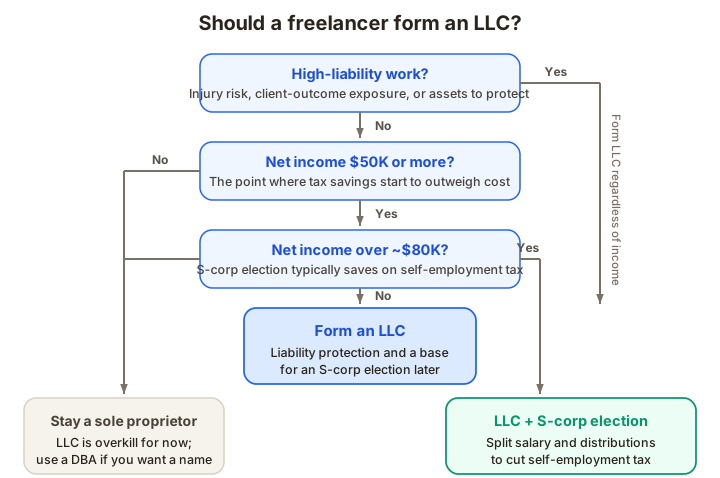
A simple decision framework
Low-liability work + modest revenue               → Sole prop is often fine.
Low-liability work + growing revenue              → Consider LLC for credibility and protection.
High-liability work + meaningful exposure         → Review entity and insurance options promptly.
Growing profits + admin tolerance                 → Consider S-corp election.
Strong profits + recurring admin budget           → S-corp election may make sense.
The decision isn't binary or permanent. You can start as a sole prop and form the LLC at the right inflection point, or dissolve it later if the cost-benefit shifts. Match the structure to where the business actually is — not where you hope it'll be in five years.
Once you've formed the LLC, the how to invoice an LLC article covers the document-side details: legal name format, EIN handling, single vs multi-member treatment.
Frequently asked questions
- What does an LLC actually protect me from?
- State LLC law may separate members from certain company debts and obligations, but protection is not absolute. Personal guarantees, the owner's own wrongful acts, professional-liability rules, payroll or tax obligations, inadequate separation, and other exceptions can create personal exposure. Entity choice and insurance should be reviewed together under state law.
- When is an LLC overkill?
- If your freelance work is low-liability (writing, design, digital services where the worst-case is 'client doesn't like the work') and you're early in your business, an LLC might be more paperwork than benefit. Sole proprietorship is often fine until the protection or tax flexibility starts to pay for itself.
- Will an LLC save me on taxes?
- By default, no, single-member LLCs are taxed like sole proprietorships. The tax savings come from electing S-corp status, which lets you split income into salary and distributions. Whether that saves money depends on your net income and your filing costs; for many freelancers it only starts to make sense once profits are clearly high enough to support the extra admin.
- How much does it cost to form and maintain an LLC?
- Formation and maintenance costs vary a lot by state. Filing fees may be modest, but annual fees, registered-agent costs, and CPA or payroll costs can add up quickly. Some states are much more expensive than others. If you want privacy, a registered-agent service keeps your home address off public records. If you elect S-corp status, budget for payroll and a more complex return.
- Should I file the LLC myself or use LegalZoom / Northwest Registered Agent?
- Filing yourself is straightforward in most states, and the Secretary of State's website usually walks you through it. The main trade-off is convenience versus doing it yourself. Either way, the LLC is the same legal entity once filed; you're paying for convenience, not legal magic.
- When should I form the LLC, before starting or after?
- You can begin as a sole proprietor and form an LLC later, but the new entity does not automatically rewrite earlier contracts or liabilities. Timing should account for state formation, contracts, licenses, banking, insurance, tax elections, and transfer of business assets.
- Do I need a separate bank account for the LLC?
- Yes, absolutely. Mixing personal and business funds in the same account can weaken the separation between you and the entity. Open a business bank account immediately after the LLC is formed. Run all business income and expenses through it. Pay yourself by transferring from the business account to your personal account (this is called an 'owner's draw' for sole-prop LLCs, or a 'salary' if you're S-corp elected). Keep books that match what's in the account.
- What about a sole proprietorship's DBA, does that give me liability protection?
- No. A 'doing business as' (DBA) is just a registered trade name; it doesn't create a separate legal entity. If you operate as 'John Smith dba Smith Consulting,' you're still a sole proprietor and personally liable for business obligations. DBAs are useful for branding and for opening a business bank account in the trade name, but they do not create liability protection. For protection, you need a real entity: LLC, S-corp, or C-corp.